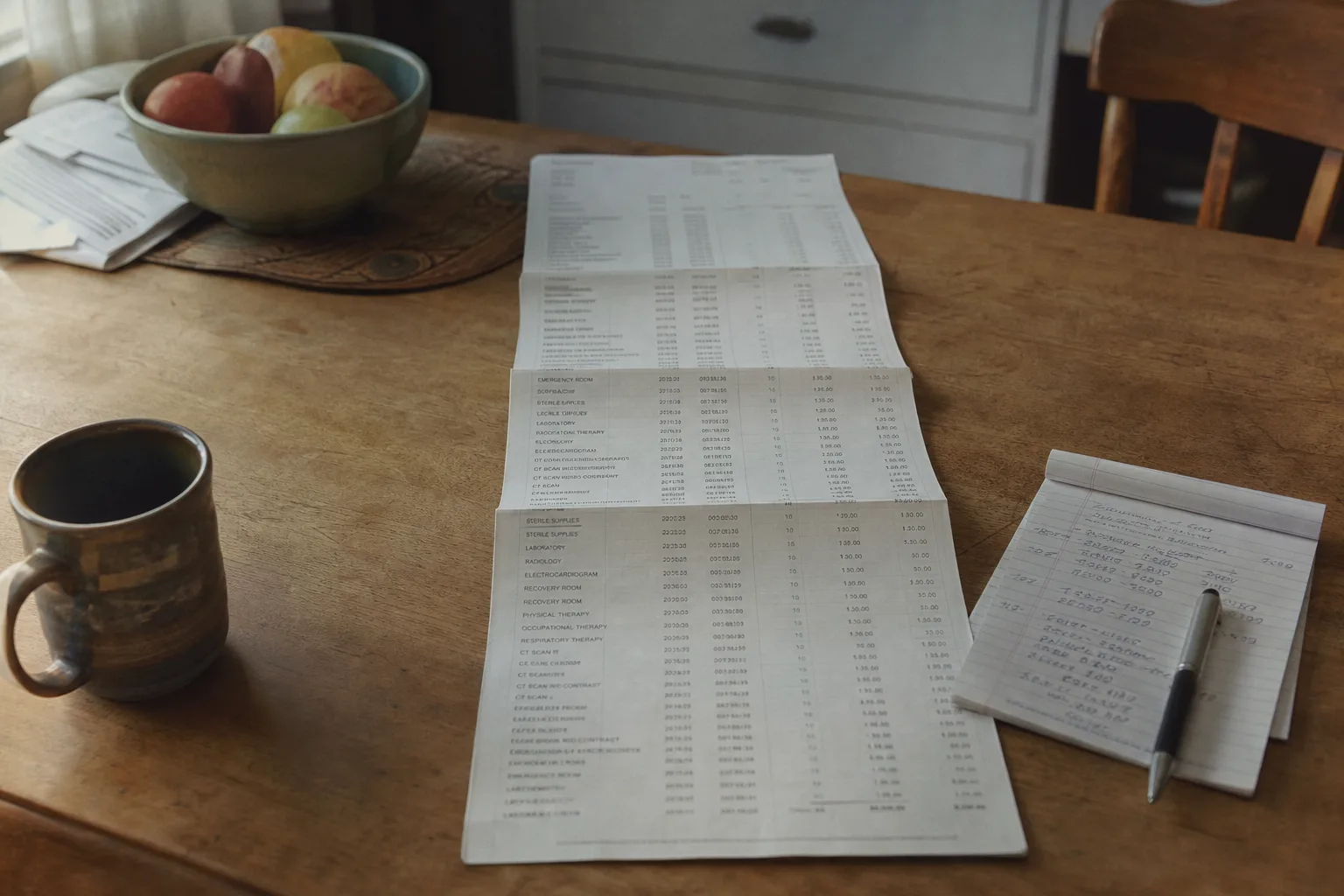
If you paid a hospital bill you now suspect was wrong, you have not lost your chance to challenge it. Refunds for overbilled accounts happen routinely, and the person who can start one is rarely the person who answered the phone when you called to pay. The same is true if the bill is months old, already in collections, or sitting in a drawer because the first attempt to understand it went nowhere.
The useful move is not to argue harder. It is to figure out which of several separate people produced the number in front of you, then take your question to that person's desk rather than to the general billing line.
First, work out which document you are actually holding
Most people's first mistake is paying a document that was never a bill. After a visit, three different papers arrive, often in the wrong order.
The explanation of benefits comes from your insurer. It is not a bill, and it usually says so in small print. It shows what the provider charged, what the plan allowed, what the plan paid, and what it believes you owe. The patient statement comes from the provider and shows a balance, usually as a single lump with a line like "hospital services." The itemized bill is the document with the actual line items on it, and almost nobody sends it unless you ask.
Compare the patient statement against the explanation of benefits before you pay anything. If the provider's statement asks for more than the explanation of benefits lists as patient responsibility, stop there. That gap is either a billing error, a claim the insurer has not finished processing, or balance billing that may not be permitted. None of those three get resolved by paying.
Ask for the itemized bill, then read it in the order the money moved
Call and ask for an itemized statement with CPT and HCPCS codes, revenue codes, dates of service, and units. Say you want it for review. Providers produce these as a matter of course. While you are on the phone, ask for the account to be placed on hold pending itemized review, and write down the name of the person who agreed to it.
When it arrives, read each line in this order:
- Date of service. Charges dated to a day you were not there, or a room charge for your discharge day, are among the most common and most fixable errors.
- Revenue code. A three or four digit number identifying the department: pharmacy, lab, operating room, supplies. It tells you where in the building the charge came from.
- CPT or HCPCS code. The five character code for the specific procedure, test, or item. This is the line that carries the most money and the most disputes.
- Units. Quantity. Two units of a single dose, or six of a single catheter, is a keystroke, and keystrokes get corrected.
- Charge, allowed amount, adjustment, patient responsibility. The gross charge is close to meaningless if you are insured. The allowed amount is the contracted price, and what you owe is calculated from that.
Flag anything that repeats, anything you do not recognize, and anything where the units look off. You do not need to know whether a code is right. You need to be able to say which line you are asking about.
The coder wrote your bill, and the coder can rewrite it
Here is the party almost everyone in this transaction overlooks. Your physician did not write your bill. A certified medical coder read the clinical documentation from your visit and translated it into codes. A separate charge description master, the hospital's internal price list, attached a dollar figure to each of those codes. A claims examiner at your insurer then ran the result against your plan. Three distinct jobs, three distinct places a bill goes wrong, and the billing representative who answers the main number does none of them.
That representative can read your account, take a payment, and set up a plan. They generally cannot change a code. What they can do, and what you should ask for by name, is a coding review or itemized audit of the account. The phrasing matters. "I think this is too expensive" routes you to a payment plan. "I'd like line 14, the CPT code billed at six units, reviewed by coding against the medical record" routes you to someone with the authority to amend the claim.
Coders are not adversaries in this. They work from whatever the clinician documented, and when documentation is thin or a charge was dropped twice by two departments, a review is how it gets caught. Hospitals rebill corrected claims constantly. It is ordinary work, not a concession.
Three more people who sit next to your decision
The financial counselor or patient financial advocate. Most hospitals of any size employ one. This is the person who knows the institution's written financial assistance policy, including the income thresholds and, critically, whether it can be applied to an account that already has a balance or has already been partially paid. Nonprofit hospitals are required to maintain and publicize such a policy. Many accept applications well after discharge. Ask directly: "Can financial assistance be applied retroactively to this account, and what is the application window?"
The insurer's provider relations or appeals staff. If the dispute is about coverage rather than coding, the member services line is the shallow end. Ask for the claim to go to a formal appeal and request the specific reason code for the denial in writing. A denial for missing prior authorization is a different problem from a denial for medical necessity, and they go to different queues.
The separately billing physician group. Facility charges and professional charges often come from two organizations. The anesthesiologist, the radiologist who read the scan, and the emergency physician may each bill independently of the hospital whose name is on the building. If one of four bills looks wrong, confirm which entity issued it before you spend an hour with the wrong billing office.
The Centers for Medicare & Medicaid Services oversees hospital price transparency requirements, and hospitals now publish standard charge information. If you are uninsured or paying cash, that published file is worth pulling before you negotiate.
If you already paid, or it already went to collections
An overpayment is a credit balance on the account, and providers process refunds for credit balances as a normal part of month-end work. Put the request in writing, reference the specific lines you are disputing, and ask for confirmation of the refund method and timeline. If a corrected claim goes back to your insurer and the allowed amount drops, the refund follows automatically in many systems, but it is worth asking rather than waiting.
If the account has gone to a collection agency, call the provider, not the agency, and ask whether the account can be recalled pending review. Providers recall accounts when a billing question is open or a financial assistance application is pending. Make the request on the same call where you request the coding review, so there is one record of both. Then send a written dispute to the collection agency as well, which puts their collection activity on hold while they verify the debt.
Keep a single page of notes: date, who you spoke with, what they agreed to, and any reference or ticket number. When a bill has passed through a coder, a chargemaster, a claims examiner, and an agency, your own record is often the only document that tracks the whole chain. It is also what makes the next call take ten minutes instead of forty.
Bills that have been reviewed line by line tend to come back smaller, and the people who do the reducing are salaried staff doing their jobs rather than anyone you have to win over. Ask for them by title, point at a line number, and give them something specific to check.