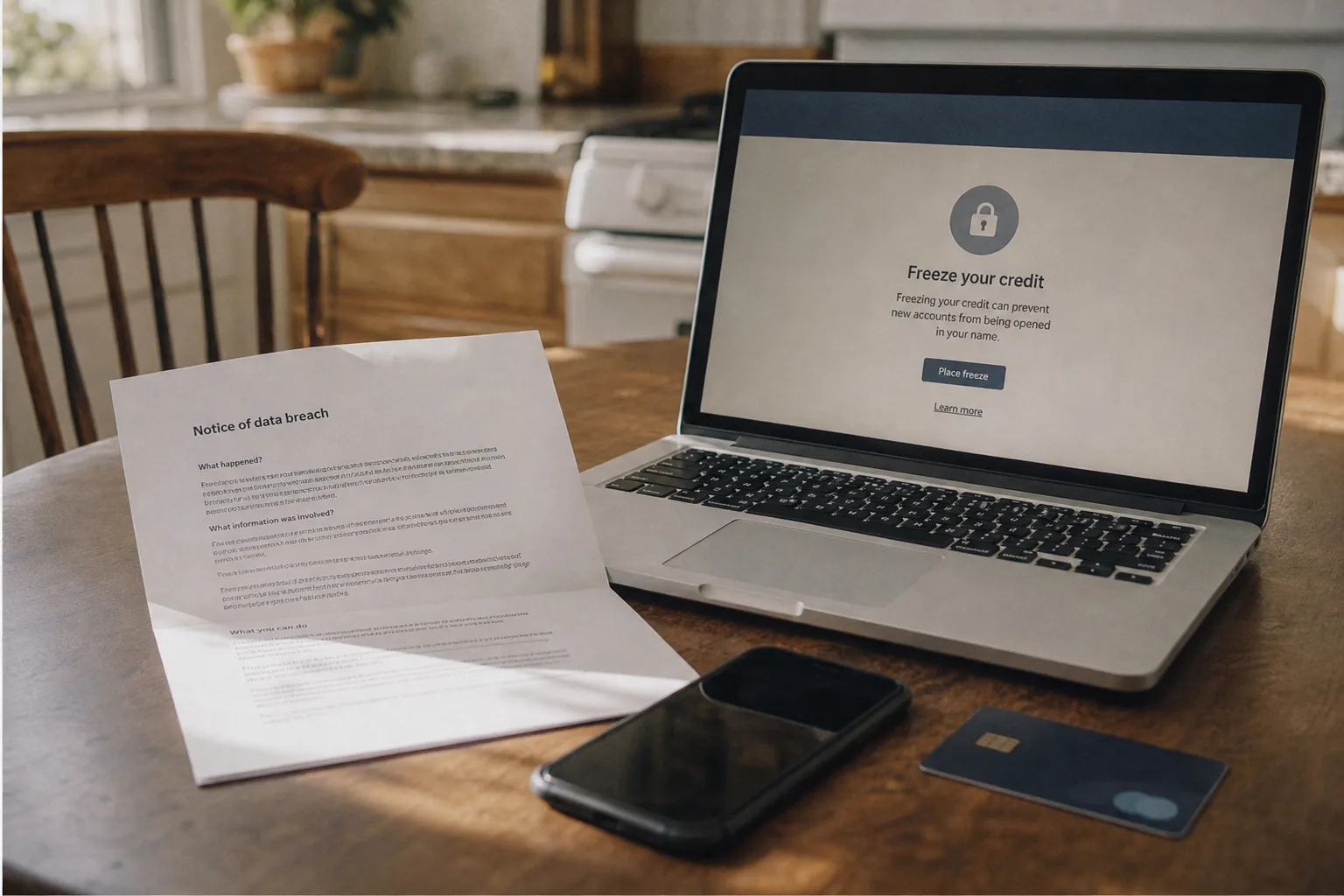
The response to a breach notice should be sized to what was taken, and almost nothing else. Not the size of the company, not the tone of the letter, not how angry you are. A large provider losing your email address and a large provider losing your Social Security number and date of birth are two different events that arrive in identical envelopes, and the whole job is telling them apart in the first five minutes.
Most people either do nothing or do everything. Doing everything costs a weekend and tends to burn out the attention you will need the next time, because there will be a next time. Judgment here is learnable, and it comes down to four questions you can run in order.
One: what class of data left, and can it be reissued?
Sort what was taken into two buckets. Reissuable items can be replaced by somebody: a card number, an account password, a member ID, a policy number. Permanent identifiers cannot: Social Security number, date of birth, mother's maiden name, driver's license number, medical history, biometric records.
A breach confined to the first bucket is an afternoon's work. Replace the thing, watch the account for a month, move on. A breach that includes anything from the second bucket is a different category, because the exposure does not expire when you change a password. It sits in circulation indefinitely and surfaces when someone tries to open credit in your name, file a return before you do, or get treatment on your insurance.
Read the data categories in the notice literally. Large providers write these lists with counsel involved, and the list is usually accurate about what is on it. What it is less reliable about is what is missing, because investigations stay open. A notice that says "may have included" is telling you the forensic work did not rule it out.
Two: how deep in the chain was the breach?
This is where the scale of the organization matters. A regional credit union with one core system has a short blast radius. A national insurer, a hospital network, or a payroll processor sits on top of dozens of subprocessors, claims administrators, print vendors, and analytics contractors, and your record may have been in a file that a vendor's vendor was holding for a reason nobody explained to you.
Two practical consequences. First, the same underlying incident can generate several letters over several months from companies you have never heard of, and they are not separate events. Second, large-provider breaches tend to involve structured records rather than scraps: name, address, date of birth, government ID, and account history in one row. Structured records are worth more to whoever bought them, and they are what identity theft is actually built from.
If the notice names a third-party file transfer product, a claims clearinghouse, or a "business associate," you are probably looking at a bulk record set rather than a handful of mailboxes.
Three: what is the organization offering, and what is the deadline on it?
Large providers almost always offer something: credit monitoring, identity restoration services, sometimes a dedicated call line staffed by people with access to the incident record. The monitoring is worth enrolling in, with one caveat. It is a detection service, not a prevention service. It tells you after something happened.
The prevention tool is a credit freeze at each of the three nationwide credit bureaus, which you place yourself, for free, and which does not depend on the company's offer or its enrollment window. The Federal Trade Commission is responsible for federal consumer protection around data security and maintains the government's identity theft recovery process, and freezing is the step it points people toward first. A freeze blocks new account openings until you lift it. If a permanent identifier was in the breach, freeze first and enroll second.
Watch the enrollment deadline on the offer. It is usually printed once, in small type, and it is typically counted from the letter date rather than the date you opened it. Put it in your calendar before you put the letter down.
Four: what else in your life uses that identifier?
This is the question that separates a good response from a thorough-looking one. Ask what other systems treat the exposed item as proof of identity.
- A date of birth plus the last four of a Social Security number unlocks phone account changes at most carriers. Add a PIN or port-out lock to your mobile account.
- An exposed email address that is also your password reset address for banking is worth more than its own contents. Turn on app-based two-factor authentication there before anywhere else.
- A driver's license number can be reused for synthetic identity applications. Your state DMV can tell you whether it issues a replacement number, and some will.
- Health records support insurance fraud that shows up in your explanation of benefits, not your credit report. Read the next two EOB statements line by line.
You are mapping the identifier outward rather than reacting to the company that lost it.
Keeping the judgment for next time
Start a plain file, digital or paper, with one line per notice: date, company, data categories, what you did, when the monitoring expires. Three letters in, the file starts doing real work. It tells you whether a new incident adds exposure or repeats exposure you already addressed, and it gives you dates and reference numbers if you ever need to document that something was out of your hands.
The letter you are holding is a record of someone else's failure that has already been contained on their end, and the useful part is that it arrived at all. Run the four questions, take the two or three steps the answers point to, and file it.