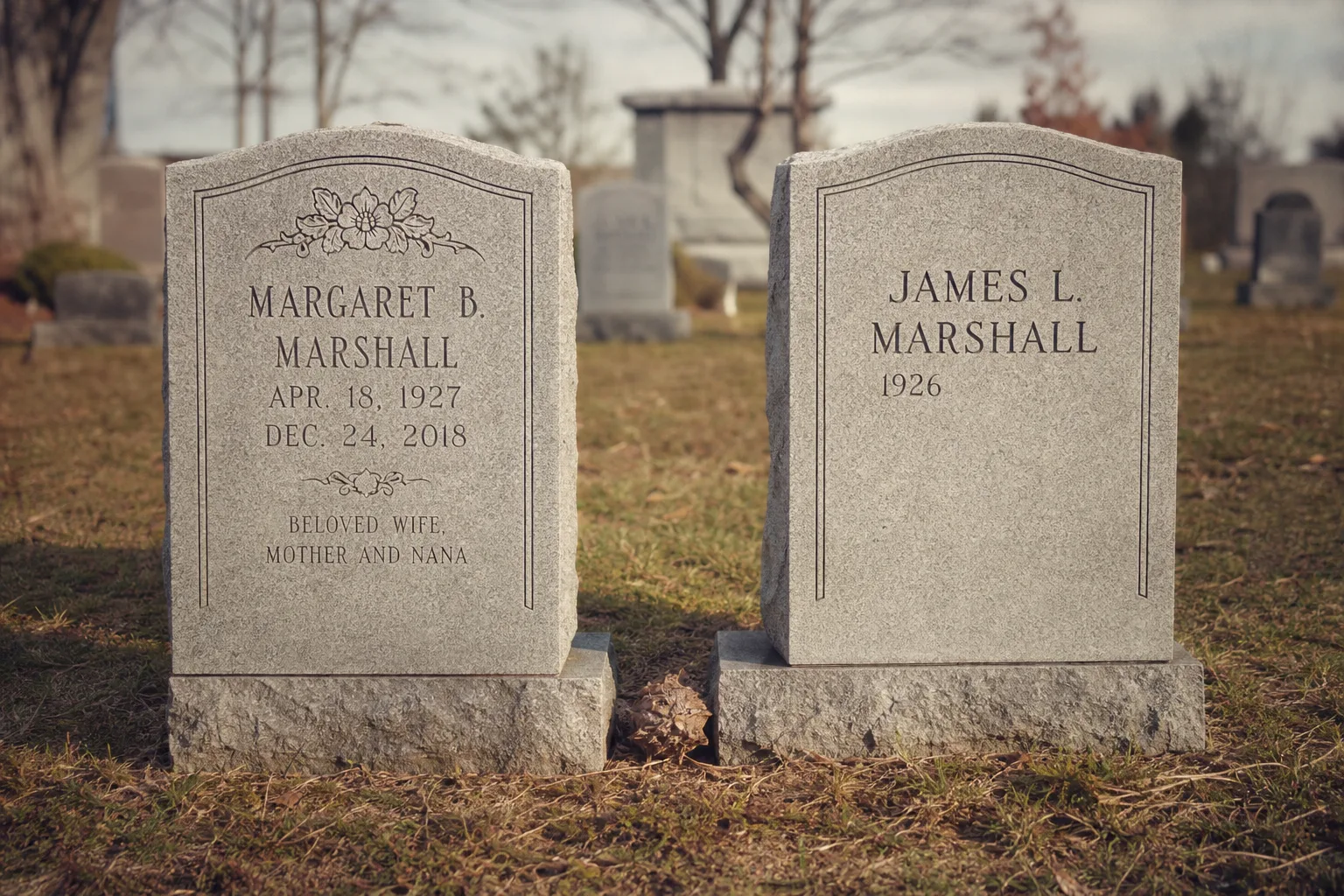
If you are ordering a monument with two names on it and only one of those people has died, you are not making one purchase. You are making two, separated by a span of years nobody can predict, and the second one will be carried out by a different stonecutter working from whatever record survives. The record is the whole game. A family that keeps four pieces of paper together in one envelope gets a matched stone twenty years later for a few hundred dollars. A family that keeps nothing pays for a site visit, a rubbing, a guess at the granite lot, and lives with lettering that does not quite match.
This is the narrow case worth working through properly, because it is extremely common and almost never explained at the point of sale. The companion marker, half-inscribed, waiting.
The proof sheet is the contract. The catalog page is advertising
Every monument dealer who has been at it for twenty years runs the same sequence, and the sequence exists because of disputes. You pick a shape and a stone. Then you get a layout proof: a scale drawing showing the exact lettering, its size in inches, its style, its placement on the die, and the carving method. You approve the proof in writing. Only then does the stone get stenciled.
The proof is the document that matters, because it is the only one that describes what you will actually receive. A catalog photograph shows a font at a size that is not your size, on a stone color that is not your lot, under lighting you will never see at the cemetery. The proof shows your inscription, at your dimensions. Read it like a closing document. Check the spelling of the surname. Check the dates digit by digit, including the century. Check that a middle initial that appears on the obituary also appears here, or decide deliberately that it should not.
Ask for the proof at full size if the dealer can produce one, or ask for the dimensions to be printed on the drawing in inches. A veteran dealer usually volunteers this without being asked, because they have had the conversation where a family stands at the installed stone and says the letters look smaller than they expected. They are not smaller. They are two and a quarter inches, exactly as drawn, and the stone is simply bigger than the drawing was.
Keep a copy of the approved proof. Not a photo of it on a phone that will be replaced in three years. A paper copy, and a scan filed somewhere a surviving family member can find it.
The second inscription is a separate job with its own obstacles
Here is the part that catches people. When the second person dies, the stone is already set on its foundation in the ground. The dealer has two options: cut the new date on site, or lift the die, haul it back to the shop, cut it, and reset it. On-site lettering is faster and cheaper and is what usually happens. It is also carving done outdoors against weather, which is why the match depends so heavily on the original record.
Three things drift in the intervening years. Granite weathers, so a freshly cut letter reads brighter than a letter cut in 1998 and will for a long time. Lettering styles get retired and replaced by near-identical digital versions that are not actually identical. And the original stencil, which the first dealer may have kept on file, gets discarded when a shop moves, sells, or closes.
A dealer who has handled thousands of headstones for graves in the same few counties will keep an archive file against exactly this: the approved proof, the font name and point size, the granite quarry and color designation, the carving depth, and the cemetery's foundation specification. Ask at the time of the original order whether that file exists and how long it is retained. Then ask for a duplicate copy for your own records, because a shop's archive is only as durable as the shop.
There is a second choice to make at the original order, and it is easier to make now than later. Some families have the surviving spouse's name and birth year cut at the same time as the first inscription, leaving only the death date for later. Some leave the entire second half blank. Cutting the name and birth year up front guarantees a perfect match on everything except the final four digits, which is the strongest argument for it. The argument against is personal rather than technical, and people feel differently about seeing their own name on a stone. Either answer is defensible. Making the decision deliberately, with the dealer explaining the match consequences, is the part that matters.
Four documents, one envelope
The paperwork that makes the second inscription routine is short, and it is almost never assembled by anyone unless they are told to assemble it.
| Document | Why it matters later |
|---|---|
| Approved layout proof | The only description of font, size, placement and carving depth. Lets a new dealer reproduce the first inscription without guessing. |
| Cemetery installation permit or monument application | Shows the memorial was approved under the rules in force at the time. Protects against a later objection to size or material. |
| Foundation work order | Records who poured the base, to what dimensions, and in what year. Relevant if the stone ever settles or needs resetting. |
| Interment rights deed or certificate | Identifies who currently holds the right to authorize work on the grave. This is the document that stalls second inscriptions. |
Add the dealer's written warranty if one was issued, and the receipt for any endowed care or perpetual care contribution the cemetery collected. Those two are less about the inscription and more about who pays when something goes wrong with the setting.
The Federal Trade Commission oversees how funeral goods and services are priced and disclosed to families, and the habit it has built into the industry (written itemization before money changes hands) is the same habit worth applying to the monument. Get the price broken into stone, lettering, foundation, cemetery permit fee, delivery and setting. A quoted lump sum hides which line will recur in twenty years.
Who signs, and what happens when that person is gone
Cemeteries do not take instructions from whoever shows up. They take instructions from the holder of the interment rights, and a second inscription is work on the grave, so it requires that authorization just as the original setting did. This is where the edge case bites. The person who ordered the companion monument is often the surviving spouse, and the surviving spouse is the person whose death triggers the second inscription. The authority to order the work and the reason to order it arrive at the same moment.
Work this out in advance and it is a non-event. Find out from the cemetery office how rights pass on the death of the holder: by the terms of the deed, by a named successor on file, by the will, or by an affidavit from the next of kin. Record a successor now if the cemetery accepts one. Tell the person named that they hold it, and tell them where the envelope is.
A dealer who has run this many times will often ask the question directly during the first order, because they have watched families wait weeks for an affidavit to clear while the stone sits with a blank panel. Asked early, it takes one phone call to the cemetery office.
Inspect before the truck leaves
When the monument is set, go look at it with the proof in hand. Check the inscription against the drawing letter for letter. Check that the die sits square on the base and the base sits level on the foundation, with no visible gap on one side. Check that the stone is centered on the lot as the cemetery approved it, not pushed toward a neighboring grave.
Anything found in the first week is a correction the dealer handles. The same thing raised three years later is a conversation about whether settling occurred naturally. Photograph the installed stone from the front and from each side, date the photos, and put them in the envelope with everything else.
The companion marker rewards one afternoon of organization at the worst possible time, and the payoff lands decades later on someone who will be grateful the file existed. Build the envelope, name the successor, keep the proof. The second inscription then becomes what it should be: a phone call, a date, and a stone that matches.