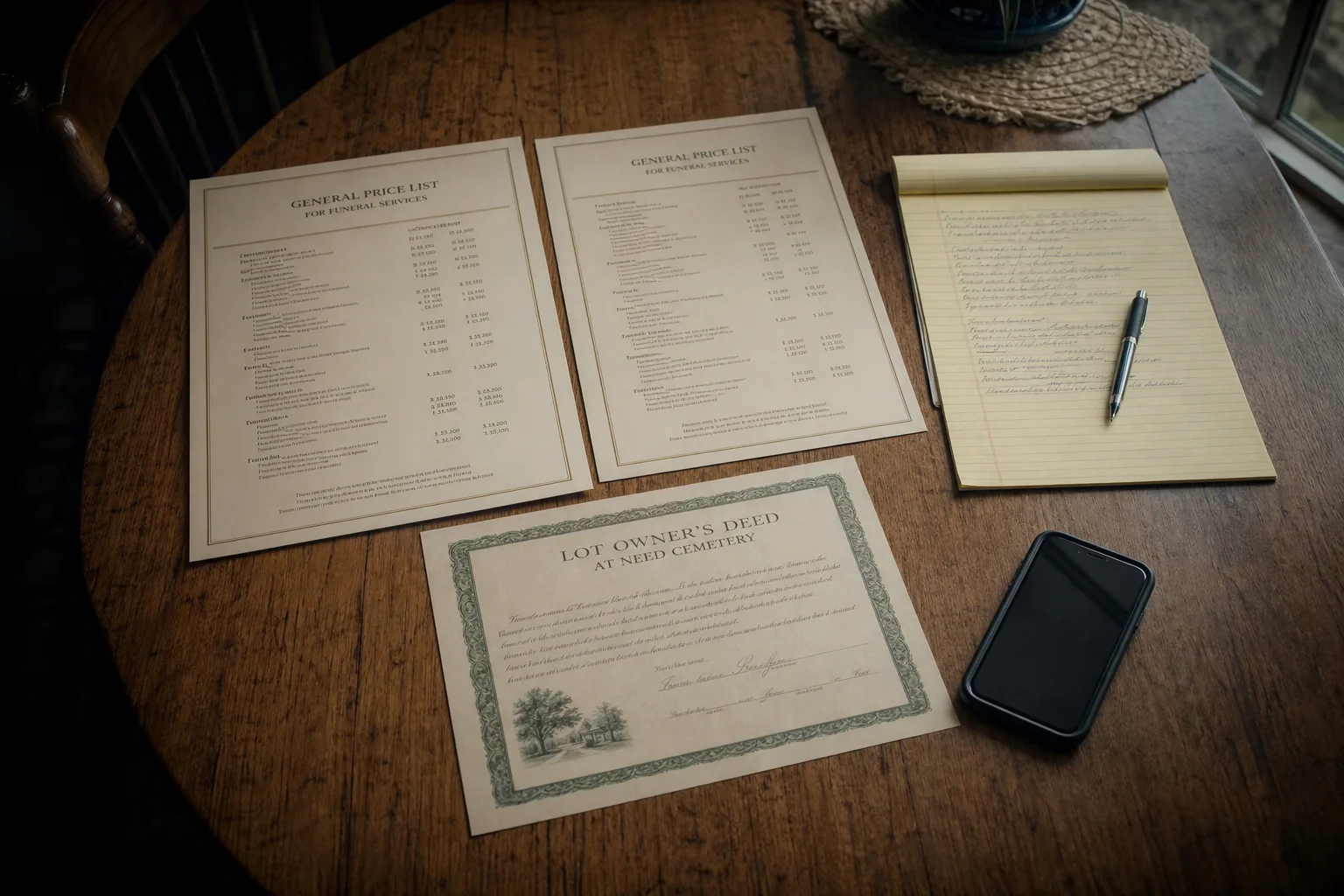
If someone dies several states away from the cemetery where they will be buried, you are going to pay two funeral homes, not one. That is the fact that shapes the whole first week. The one nearest the death handles custody, paperwork and transport out. The one nearest the cemetery handles the service, the burial and everything the family sees. Deciding which of those two is in charge, on day one, is the single choice with the biggest effect on the total.
This is a narrow situation, but it comes up constantly: a parent dies while visiting a sibling, or in a rehab facility near the daughter who was managing care, and the plot is 600 miles away next to a spouse. Below is the order it actually runs in, and where the money goes at each step.
Day one: custody, and the phone call that sets the price
Someone has to take the body into their care within hours. If death happened in a hospital or a nursing facility, they will ask which funeral home to release to, and they will keep asking. If it happened at home, the situation may go to the county medical examiner or coroner first, and nothing moves until that office releases the case.
Here is the part families get wrong. The instinct is to call the local funeral home in the town where the death happened, because it is urgent and they are close. That is fine, but you should call the funeral home near the cemetery first, and let them nominate the local firm.
Funeral homes in the destination town have working relationships with firms across the country. They call a counterpart, agree a price for what the trade calls forwarding remains, and that number comes through as a single line on your bill rather than as a separate contract you negotiated cold at midnight. Handled the other way around, you sign a full arrangement with the local firm, including items the destination home will charge for again, and you find out about the overlap when the second contract arrives.
Whichever way you go, the Federal Trade Commission's Funeral Rule governs how prices are disclosed. It requires an itemized general price list, and it requires the funeral home to quote prices over the phone if you ask. You can ask for the forwarding price before agreeing to anything, and you should, because you are calling from another time zone with no ability to walk in.
Days one to three: the death certificate is the gate
Nothing crosses a state line without paperwork. The body cannot be transported out of the state where death occurred until a physician or the medical examiner signs the medical portion of the death certificate and the local registrar issues a burial-transit permit. The funeral director files this, but the delay is not in their hands.
This is where an out-of-state death costs more than a local one, and it is not a line item anyone quotes you. Every day of waiting is a day the body is in someone's care, and care carries a daily charge in most price lists once you pass the included period. If death occurred on a Friday, or over a holiday, or if the attending physician is off rotation, three days becomes six. The medical examiner cases run longer still.
Ask two questions on day one: who signs, and have they been reached. If the answer is vague, ask the funeral director to tell you what the daily holding charge is after the included days, so you know what the wait costs while it accrues rather than afterward.
Order certified copies now, and order more than feels reasonable. Life insurance, retirement accounts, the bank, the title company and the DMV each want an original with a raised seal. They are cheapest bought at the same time as the first batch.
Days two to four: how the body travels, and what each route costs
There are three realistic routes, and the cost gap between them is large.
- Livery by road. A funeral coach or transport van drives the distance. Priced by the mile, sometimes with a two-driver charge past a certain hour. Predictable, and often the cheaper option inside about 400 or 500 miles.
- Air. The body is embalmed, placed in a shipping container (an air tray, or a combination unit), and moved as air cargo. You pay the airline's charge by weight, plus a shipping container, plus a delivery to the departure airport, plus the destination funeral home's run to collect it. Airlines require the shipper and receiver to be licensed funeral establishments, which is another reason both firms are involved.
- Cremation where death occurred. The local firm handles the cremation, then the cremated remains are mailed. The Postal Service is the only carrier that ships them domestically, and it requires Priority Mail Express with a specific label. The transport cost drops to postage.
Embalming deserves a plain note. It is not legally required in most ordinary circumstances, and the Funeral Rule requires disclosure of that. But airlines and some receiving states impose their own conditions on transporting a body across a distance, and in practice interstate air transport usually means embalming. That is a carrier and state requirement, not a sales pitch, and a director who explains it that way is telling you the truth.
Days three to six: the destination bill, which is the bigger one
Once the body arrives, the destination funeral home charges receiving remains, then the ordinary arrangement: the basic services fee, the casket, use of the facility for a viewing or the service, the hearse, staff. Then the cemetery, which bills separately and is not the funeral home's revenue: the grave opening and closing, and often a second charge if the burial falls on a Saturday or after normal hours. If the plot was bought decades ago, the deed still has to be located and the interment right confirmed. Cemeteries also set their own rules on outer burial containers.
Two things reliably cut this total without cutting anything a family would notice at the graveside. First, holding the visitation at the church or the graveside rather than renting the funeral home's chapel for an additional block of hours. Second, deciding early whether there will be a viewing at all, because the answer changes the casket, the preparation and the facility charges in one move.
The version that costs least, and when it fits
Cremation in the state where death occurred, mailed home, with a graveside committal and a memorial service scheduled two or three weeks out. It removes the air freight, the shipping container, the receiving fee and most of the holding days, and it takes the deadline off the family. For a burial next to a spouse, an urn goes into an existing plot in most cemeteries, though the fee schedule and the rules on that vary and should be checked before you commit.
It does not fit every family. Where burial of the body matters, it matters, and the forwarding route is what it is. But the choice is worth making deliberately on day two, with both price lists in front of you, rather than by default at eleven at night on the phone from an airport.
The families who come out of this week in good shape are the ones who made one call before all the others: to the funeral home near the cemetery, asking them to arrange the far end. Everything downstream gets easier from there.