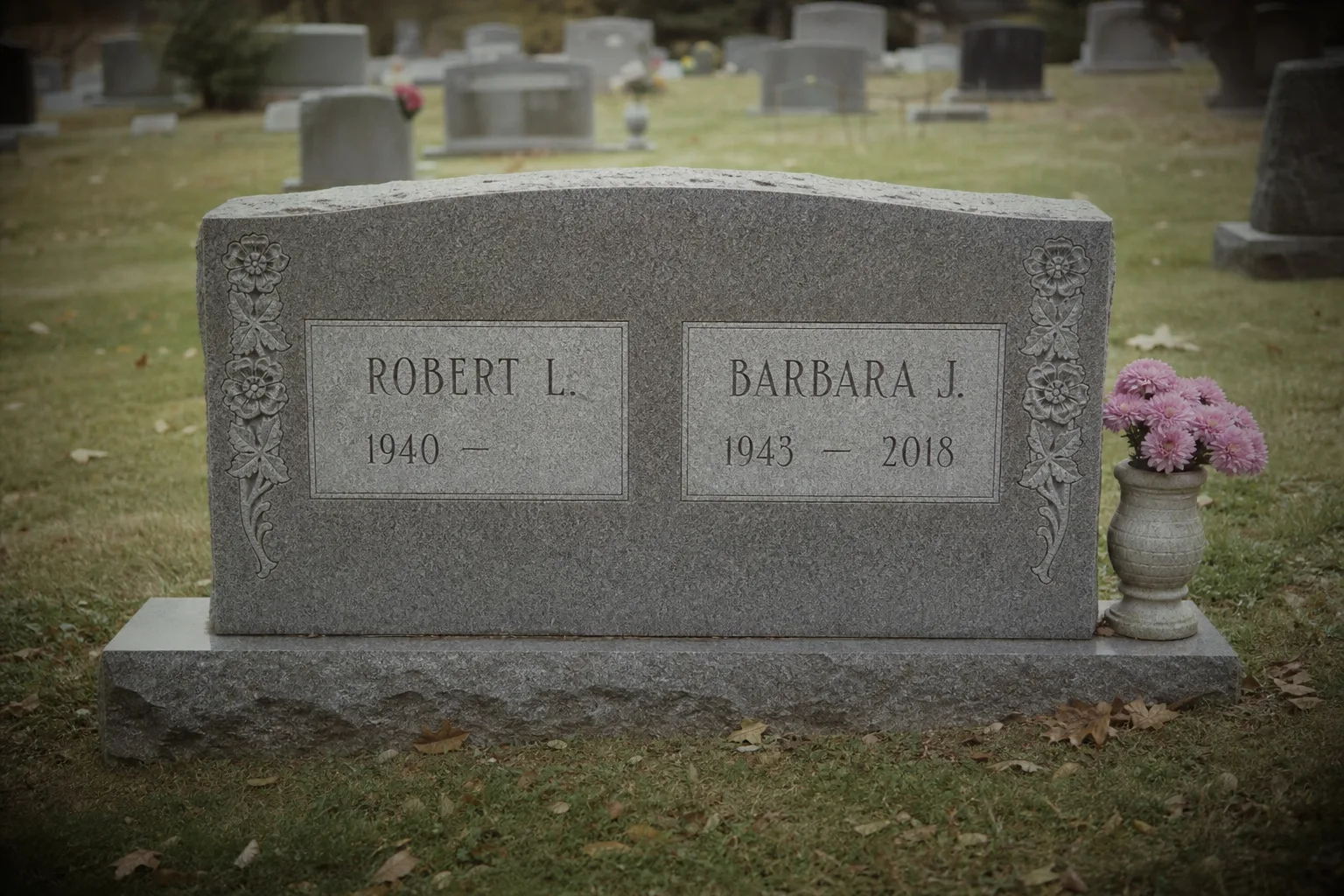
If you ordered a companion monument after a spouse died and had your own name cut into the other half, the thing you can still change is smaller than you probably fear and larger than the monument dealer implied. Spelling and layout are effectively permanent once the stone is sandblasted. Almost everything about the second date is not, because that line was designed from the start to be finished later, by someone else, years after the invoice cleared.
The double stone with one blank date is the most common irreversible purchase in the memorial trade, and it is worth understanding why it is built that way before deciding whether yours needs correcting.
How the blank date became the default
Nineteenth century markers were cut one at a time by a local stonecutter, often in slate or marble quarried within a day's cart ride, and lettered by hand with a chisel. Lettering was labor, so it was bought in the smallest quantity that would do the job. A stone was ordered after a death, for that death.
Two changes ended that. Granite replaced marble as the standard material, because it holds an inscription against acid rain and freeze cycles in a way marble does not. And sandblasting replaced the chisel: a rubber stencil is cut, laid over the polished face, and the exposed letters are blasted out in one pass. Once the setup cost dominates the job, cutting eight lines costs barely more than cutting four. So the trade began selling the whole family unit at once. One base, one die, two names, two birth years, one death date and a gap.
Cemeteries encouraged it. A single foundation poured once, in a section with uniform setbacks and a single permitted footprint, is easier to mow around and easier to administer than two stones arriving a generation apart with different dimensions. The Federal Trade Commission oversees disclosure practices in the funeral industry, and the modern result of all this is a purchase that gets presented as one decision when it is really three: the stone, the inscription, and a future service nobody schedules.
What the proof settles for good
The proof, sometimes called the layout or the drawing, is the document that matters. Once you sign it, the stencil gets cut from it exactly. Read it as though it were a deed, because in practice it is.
- Name form. Maiden name, married name, both, or a nickname in quotation marks. Whichever you pick sets the tone for the surviving spouse's half, because the two sides are laid out to match.
- Spelling and accents. Diacritics get dropped silently by some shops. If the family name carries one, say so in writing.
- Line breaks and centering. The whole face is composed around two names. Adding a third person later, a child or a second spouse, usually will not fit without recutting the panel.
- Emblems and finish. A polished panel and a rock-pitched edge are milled, not printed. That shape is the shape.
Birth years for a living person are the sneaky one. Many shops will cut a birth year and a dash. That is fine. What is not easily undone is a full death date typed in error, which does happen, and which is the single mistake most worth checking before you sign.
If it is already wrong
Wrong is fixable more often than people assume, and the fix depends on where the error sits.
A misspelled or unwanted line on a polished granite face can sometimes be re-polished out and recut, if the letters were shallow and the panel has margin around them. On a rough or flamed finish, that is harder, and the honest answer is usually a replacement die on the existing base. Because the foundation and base are the heavy, expensive components, replacing only the upright stone costs meaningfully less than starting over. Ask for both quotes, the repair and the new die, and compare.
A layout you have simply changed your mind about, having decided you want a different name form or a scripture line you skipped, is often solved with a flush marker or a small companion tablet set nearby rather than by touching the existing stone. Cemetery rules govern whether that is allowed, so ask the office before you commission anything.
The second date, and who will actually order it
This is the part that gets lost. The blank line will be lettered in place, at the grave, by a technician with a portable blaster or hand tools, after a death. Somebody has to call and pay for it. Executors routinely do not know the stone exists, let alone which dealer holds the file.
Fix that in an afternoon. Write down the dealer's name, the cemetery, the section, lot and grave number, and the words you want on that line, then put the page with the will and email a copy to whoever is named as executor. Ask the dealer whether they keep the original stencil on file, and whether the in-place lettering fee was prepaid or is billed at the time. Both answers belong on the same page.
That single sheet converts a decision your family would otherwise guess at into a phone call.
What is still open
Plenty. Vase or no vase, planting rules, whether you are eventually buried there at all, and every word of a future inscription that has not been stenciled. The stone in the ground constrains less than its permanence suggests, and a dealer who will talk you through the repair options is telling you something useful about the shop.
Go look at the stone. Photograph both halves, straight on, in flat light, and read the letters against the proof you signed. Most people find nothing wrong. The ones who find something find it while it is still cheap to address.