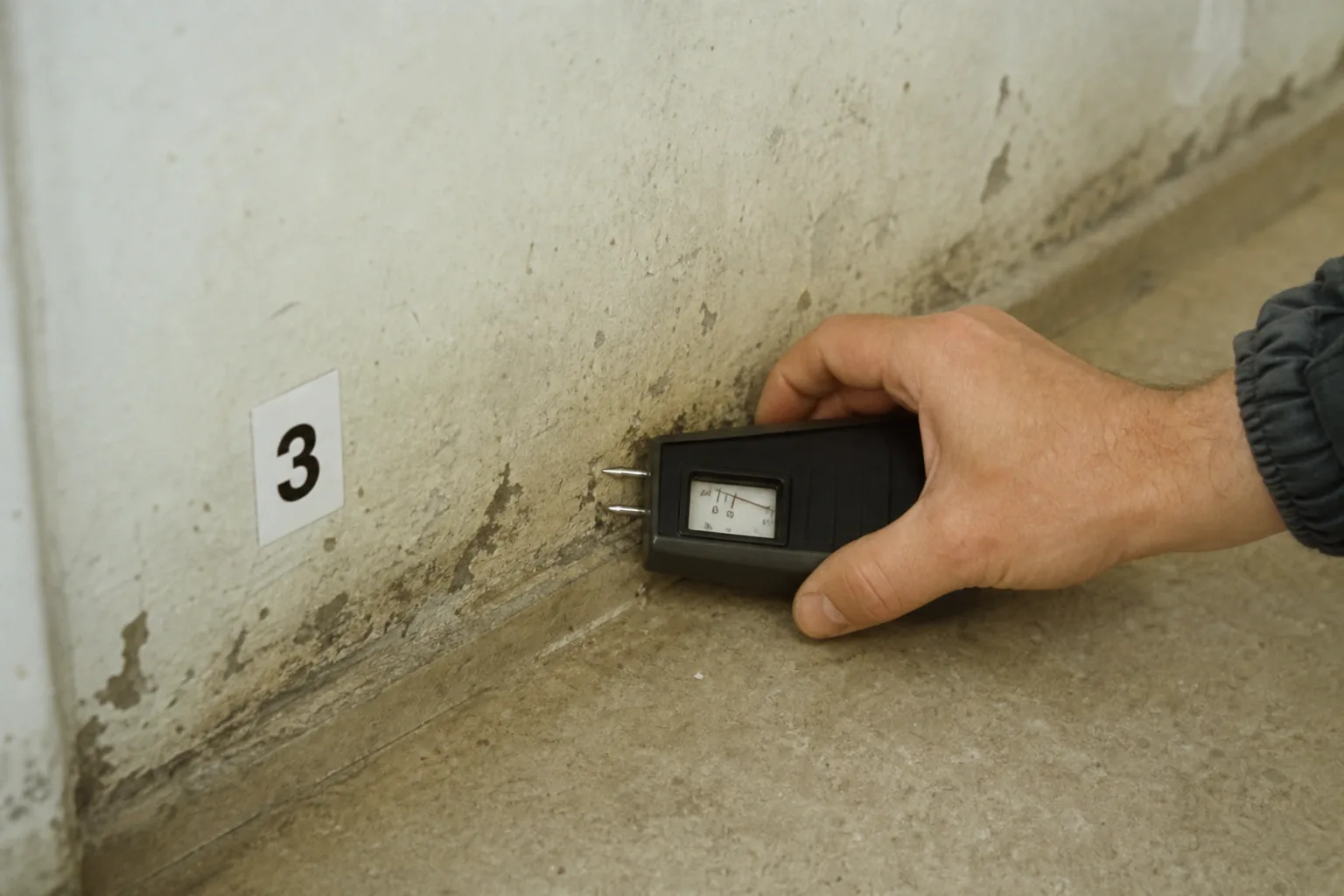
On the second morning after a water loss, a homeowner walks into a room containing four air movers and a dehumidifier, all of it loud, all of it billed daily, and none of it doing anything visible. The technician says the readings are coming down and they will reassess tomorrow. That sentence is either a description of a properly managed drying job or a description of equipment left running because nobody is measuring, and the difference between those two situations is written down in a document the homeowner is entitled to see.
What the Equipment Is Actually Doing in the Room
Drying is not evaporation happening on its own schedule. Air movers push high velocity air across wet surfaces to strip away the saturated boundary layer that otherwise sits against the material and stops it releasing moisture. Dehumidifiers then pull that moisture out of the room air, because air that has absorbed water and has nowhere to put it stops accepting any more. The two machines are halves of one system, and running fans without dehumidification simply relocates water from the floor into the walls and the air.
This is why the count of machines is not arbitrary and why an experienced technician calculates it rather than guessing. The number depends on the volume of the space, the class of the loss, and how much wet material is present, and the calculation is standard in the trade. An owner who understands that the equipment quantity is a computed figure can ask how it was computed, and the answer, or the absence of one, is informative in itself.
The Case for Getting the Fans Out Fast
Speed genuinely matters, and it is not only about the daily equipment charge. Wet material degrades continuously while it stays wet, so a subfloor that could have been saved on day two may not be saved on day six, and the cost of that failure appears as replacement rather than as drying. Microbial growth follows the same clock, which is why the industry treats the first forty eight hours as the interval in which the outcome is largely decided.
The argument for aggressive early drying is therefore an argument for more equipment sooner rather than for fewer days later, and those are not the same thing. A job run with adequate machines from hour six frequently finishes in three days, while the same job run with two fans because that is what was on the truck takes seven and loses material along the way. Speed is bought at the front of the job, and a homeowner pressing for it on day five is pressing at the wrong end.
The Case for the Job Legitimately Running Long
Some assemblies simply take longer and no amount of urgency changes the physics. Hardwood over a plywood subfloor, plaster on masonry, dense insulation inside a wall cavity, and anything under a vinyl or tile finish that seals the surface all release moisture slowly, because the water has to travel through material before it can evaporate from it. Cold weather works against drying as well, since a room that cannot be kept warm gives the dehumidifier much less to work with.
The other legitimate reason for a longer job is a change in the plan partway through, usually because opening something revealed more wet material than the original inspection found. That is not padding; it is the scope being corrected. What distinguishes it from padding is documentation, since a technician who found more water can point to the day it was found, the readings that prompted the change, and the additional equipment added in response.
Reading the Log Without Any Training
A properly run job produces a daily record with the same handful of columns: the date, the temperature and relative humidity inside the affected area, the same readings outside or in an unaffected room for comparison, and moisture readings from specific labeled points on specific materials. The labels matter as much as the numbers, because a reading taken from a slightly different spot each day is not a trend, it is four unrelated measurements.
What a homeowner is looking for is movement in one direction and a stated target. Readings should fall day over day, and the technician should be able to say what number the material has to reach, which is normally derived from a dry standard measured somewhere unaffected in the same building. A log where the numbers are flat for three consecutive days is a log that says something is wrong with the setup, and a log with no target on it at all is a log that cannot tell anyone when the job is finished.
The Questions Worth Asking on Day Two
Three questions, asked early and pleasantly, change how the rest of the job runs. What is the dry standard you are drying to, and where did you take it from. Which specific points are you measuring, and can I see yesterday’s numbers alongside today’s. And what would make you add equipment or remove it. A technician running a measured job answers all three without hesitation because the answers are already written on the form in their hand.
Asking on day two rather than day six is the entire point, since by day six the equipment charges are largely incurred and the argument has become retrospective. The homeowner who looks at the log early is not being adversarial, and most technicians are pleased to explain it, because the readings are the strongest evidence they have that the work is being done properly. The noise in the room stops being mysterious the moment it comes with numbers attached, and a job that finishes in three days and a job that honestly needs seven look completely different on paper long before they look different in the room.