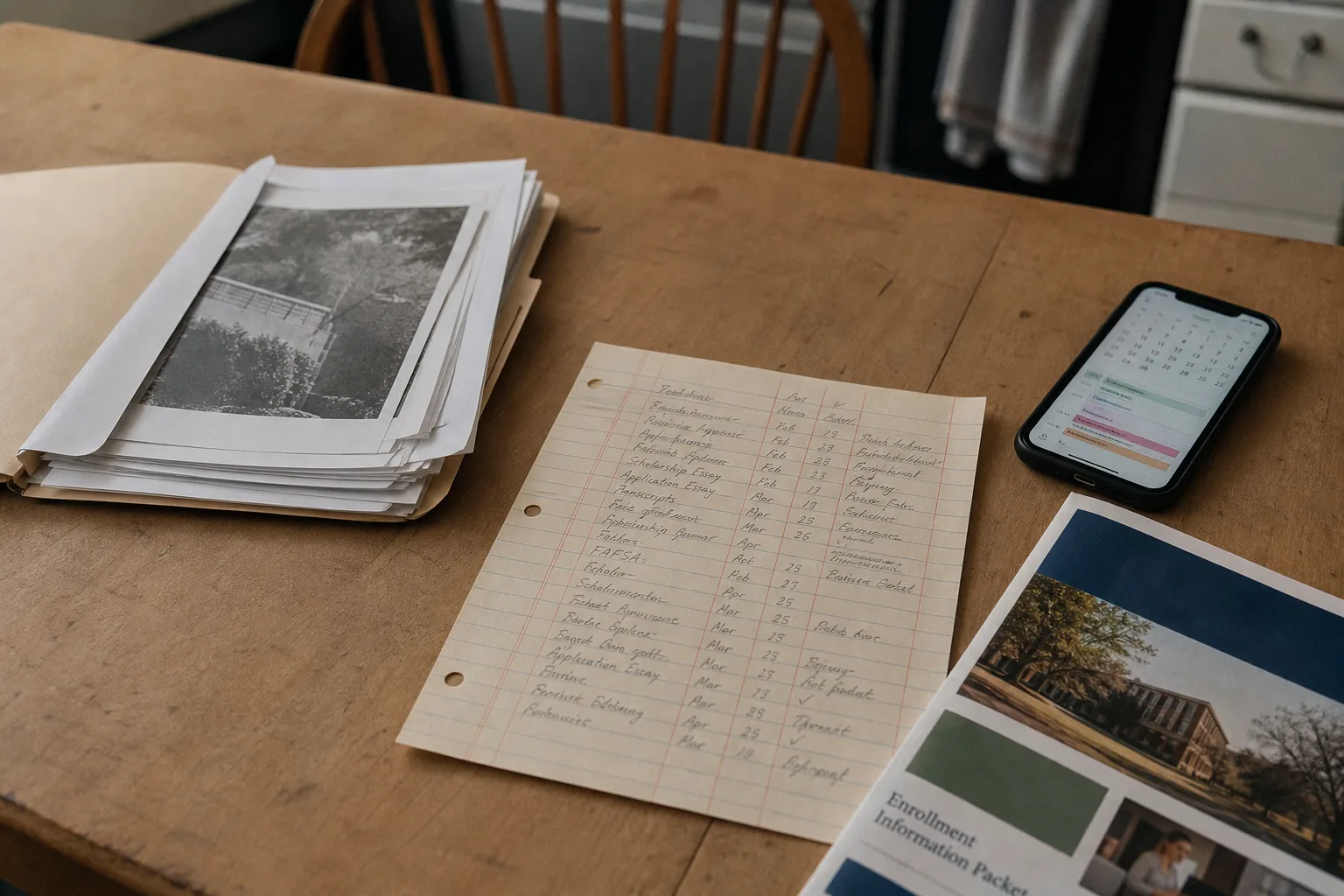
The deadline that costs people their seat in a January cohort is almost never the application deadline. It is the tuition purge date, usually two to four weeks before classes start, when the college drops unpaid registrations to free up spots. The application was submitted in September. The seat evaporates in December, on a Tuesday, without a phone call. This piece uses one narrow case, a working adult entering a practical nursing certificate at a community college with a spring start, because the paperwork in that case is heavier than most and the sequence is unforgiving. The tools that make it manageable are not complicated. One page, one folder, three calendar alerts.
1. The drop-for-nonpayment date, which is not the same as the bill's due date
Registration systems generally let you enroll in courses without paying anything. That creates a gap between the day you hold a seat and the day you have paid for it, and colleges close the gap by cancelling schedules that are still unpaid at a stated cutoff. In a competitive health program, the waitlist behind you is real, and a dropped schedule does not always get restored on the same terms.
Three things are worth confirming in writing, from the bursar or student accounts office rather than from a program advisor:
- The exact purge date and time, including whether it is midnight local time or end of business.
- Whether an approved payment plan, a pending aid award, or an employer tuition voucher counts as "paid" for purge purposes. Often a payment plan does and a pending employer reimbursement does not.
- Whether a purged schedule can be reinstated, and whether reinstatement carries a fee.
Likely outcome if you miss it: you lose the specific course sections you had, which in a cohort program can mean waiting for the next start. Merely possible: the whole cohort seat is gone. Both are avoidable with one calendar alert set ten days out.
2. Transcript requests, which move at an institution's pace and not yours
If any prerequisite was taken somewhere else, an anatomy course from years ago, a math class at a different college, a high school equivalency, the receiving school will not evaluate your file until the official record arrives. You control the request. You do not control the turnaround, and you especially do not control it in the weeks around the winter holidays, when registrars run short staffing.
The practical countermeasure is to treat every outside transcript as a thirty-day item and to order it the day you decide to apply, not the day the application closes. Two details cause most of the delays. First, a hold: an unpaid library fine or parking ticket at a school you left in 2014 will stop a transcript, and you will not be told until you ask why nothing arrived. Second, delivery format: many programs require electronic delivery to a specific address or a sealed paper copy, and a PDF you forward yourself does not count.
Keep the order confirmation number. It is the only thing that lets a clerk find your request when you call to ask where it went.
3. The aid deadline that sits earlier than the federal one
Federal student aid is administered under the U.S. Department of Education, which oversees the FAFSA and the federal aid programs it feeds. The federal filing window is wide. The deadlines that actually govern your money are narrower and they belong to other people: your state's grant program, which may award on a first-come basis until funds run out, and your college's own priority date for institutional scholarships and work-study.
For a spring start, that priority date can fall in the autumn, months before the term. Filing after it does not disqualify you from federal loans, but it can quietly cost the grant portion, and grant money is the part you do not repay. Two other dates ride alongside it:
- Verification response. If your file is selected for verification, the school will ask for tax documents. A transcript of your return can be requested from the IRS, and that request has its own turnaround. Answer verification requests the week you receive them.
- Aid disbursement timing versus the purge date. Aid frequently posts after classes begin. If it posts after the purge, you need the school to flag your account as covered by pending aid, and you need that in writing.
4. Health, background and certification paperwork that expires
Clinical placement is where a nursing program's requirements come from, and the hospital, not the college, sets many of them. Expect some combination of a physical exam, an immunization record with titers, a tuberculosis screening, a criminal background check, a drug screen, and current CPR certification at the healthcare provider level.
The trap is not difficulty. It is shelf life. A TB screening dated too early may fall outside the window on the first clinical day. A background check has a validity period. CPR cards expire on a month, not a semester. Sequencing matters too: titers can come back showing non-immunity, which means a vaccine series, which means weeks, sometimes months. Start the health packet the moment you are conditionally accepted rather than when the program asks for it.
Ask one specific question of the clinical coordinator: on what date must each item be current? Write that date down, not the date the form is due.
5. The paperwork kit that keeps all five straight
None of this needs software. It needs a single page and a habit.
The deadline ledger. One sheet, five columns: item, controlling date, who set it, what proof I have, done. Handwritten is fine. The "who set it" column is the useful one, because it tells you whom to call when something stalls, and it exposes the deadlines that belong to a state agency or a hospital rather than to your college.
One folder, consistent file names. Scan or photograph everything and name files by date first: 2025-10-04 transcript-request-confirmation. When a clerk says the office never received something, a timestamped confirmation ends the conversation in your favor within a minute.
Three alerts per deadline. Thirty days out, ten days out, and the morning of. The thirty-day alert is for starting; the ten-day alert is for chasing someone else; the day-of alert is for confirming receipt rather than confirming submission. Submission and receipt are different events, and only one of them protects you.
A proof-of-delivery habit. Portal upload screenshots, email read receipts where available, certified mail for anything paper. Keep the tracking numbers with the ledger.
Run the ledger once a week for twenty minutes and the January start becomes an administrative routine rather than a scramble. The applicants who lose seats are rarely unqualified. They are usually the ones who assumed the application deadline was the deadline, and who never asked the bursar for a date.