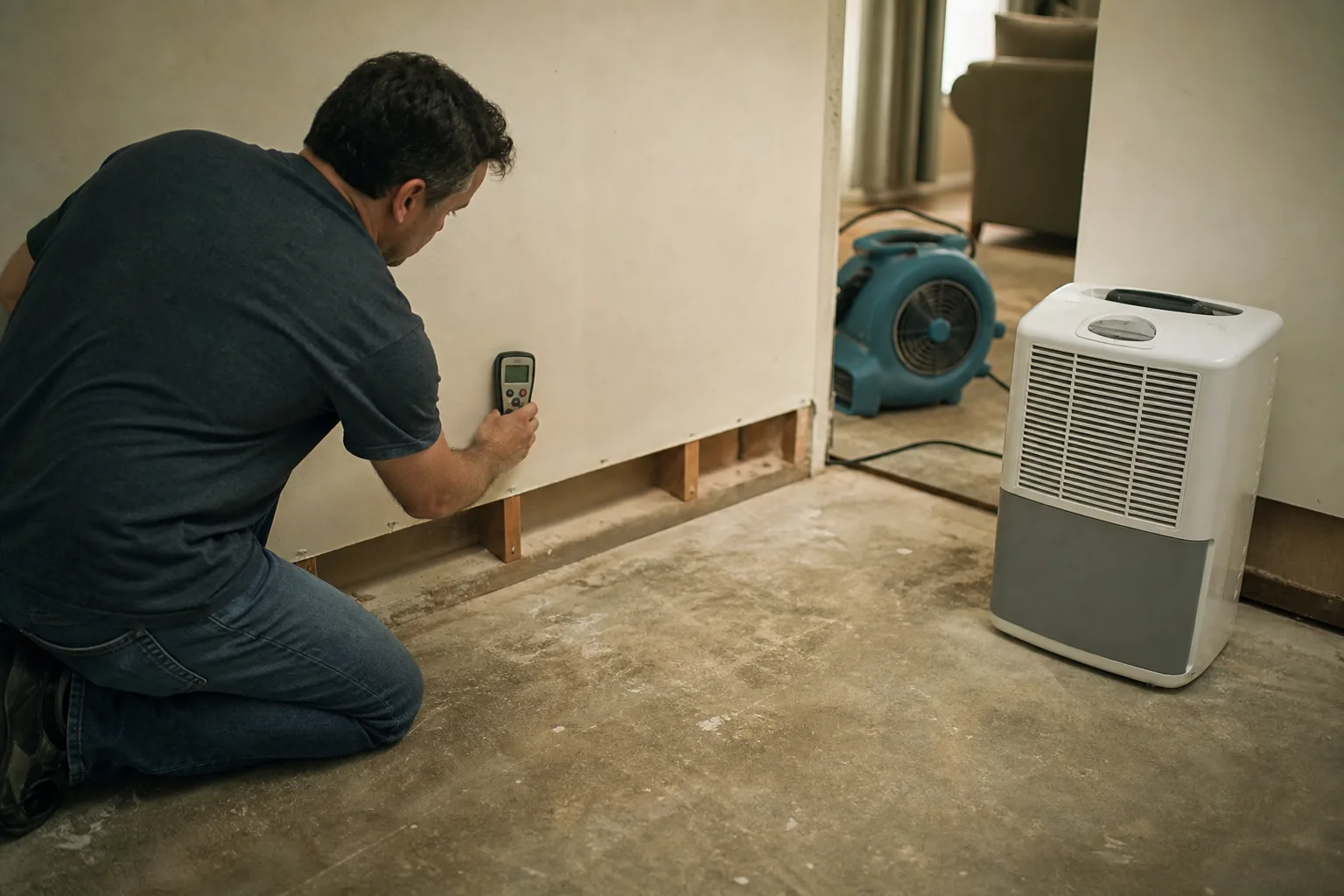
A drying job is finished when the wet material reads the same as an identical dry one in an unaffected part of the house. Not when the surface feels cool and dry to a palm, not when the fans have been running a preset number of days, and not when the smell goes away. That is the whole difference between drying properly and drying quickly, and it is the one point a household can verify without hiring anyone.
Ten years ago that verification was hard for a homeowner to do. Now it costs about the same as a decent pair of pliers.
What "dry" meant in a normal house a decade ago
The standard home response to a burst supply line or a dishwasher that let go overnight used to be volume. Rent three or four box fans, borrow a shop vacuum, open every window if the weather allowed, crank the heat if it did not. Someone would kneel down, press a hand to the baseboard on day three, and call it.
The professional version was not always far ahead of that. Plenty of mitigation work was priced on equipment days: a set number of air movers and a dehumidifier parked for three days, picked up on schedule, an invoice issued. Where the reading was genuinely uncertain, the fallback was demolition. Cut the drywall two feet up, pull the insulation, tear the carpet and pad, replace everything. That worked, in the sense that you cannot have a wet cavity if you have thrown the cavity away. It was also expensive and disruptive, and it still missed the water that had tracked under a door threshold into the next room.
The failure mode was specific and common. Surfaces dried first. The framing, the bottom plate, the subfloor seam, and the insulation behind an interior wall dried far slower, because nothing was moving air through them. The wall got closed up, painted, and looked finished. Four to eight weeks later a stain appeared, or the baseboard cupped, or the room developed a smell nobody could place.
What actually changed
Three things, and only one of them is about better machines.
The first is measurement. A pinless moisture meter that reads through a finished surface without leaving holes is now a common hardware store item at a homeowner price. So are Bluetooth temperature and humidity sensors you can leave in a crawlspace and read from a phone. Thermal camera attachments that show you the cold, evaporating patch behind the paint are no longer specialist equipment.
The second is dehumidification. Low grain refrigerant dehumidifiers pull moisture at lower humidity levels than the old refrigerant units did, which matters enormously at the tail end of a job when the room is already at moderate humidity and the last water is buried in wood. Rental fleets and restoration crews both carry them now. A hardware store rental unit is usually not one of these, which is worth asking about before you pay for three days of the wrong machine.
The third is documentation. Insurers increasingly expect a daily moisture log: readings from the affected materials, readings from a dry reference, room conditions, dated. That log is also the household's protection. It is what turns "the crew thought it was dry" into a record that shows whether it was.
The Environmental Protection Agency is the federal body responsible for guidance on indoor moisture and mold, and its long-standing position is straightforward: the fix is removing the water and correcting the source, promptly, rather than treating what grows afterward.
The three readings that decide when to stop
Moisture content of the material, against a dry standard. Take a reading on the wet drywall, subfloor, or framing. Then take a reading on the same material in a room that never got wet. When the two match, that material is dry. This is the number that ends the job. A hallway floor that reads well above the closet floor eight feet away is not dry, whatever the surface feels like.
Room conditions. Temperature and relative humidity together tell you whether the air can still accept moisture. A room at high humidity is not drying anything no matter how many air movers are pointed at it, because the water has nowhere to go. That is the single most common reason a household's own drying attempt stalls: plenty of airflow, no dehumidification, and the water is just circulating.
The trend across days. Log the readings. A drying job should show a curve that drops and then flattens as it approaches the dry standard. If it flattens early, well above the reference, the drying has stalled and more time will not fix it. Something is trapped: wet insulation in a cavity, water under a vinyl or laminate floor that cannot breathe upward, saturation under a cabinet toe kick.
A stall is a signal, not a verdict
Stalls get solved by opening a path, not by adding days. Pull the baseboard and drill a row of small holes into the bottom of the cavity so air can move through it. Remove wet fiberglass insulation, which holds water and insulates the framing from any drying you are doing. Lift a section of flooring rather than trying to dry through a vapor-tight surface. Each of these is a small, targeted opening in a specific spot, which is what replaced the old habit of cutting out everything within reach.
If you already closed it up
This is a recoverable position, and it is a very common one. Find the lowest point of the wall closest to where the water sat. Pull that section of baseboard, which comes off with a putty knife and a pry bar and goes back on with finish nails and caulk. Read the bottom plate and the drywall behind it. Compare against the same spot in a dry room.
If it reads wet, you have found it early enough that you are dealing with drying and a patch rather than framing replacement. Photograph the reading, date it, and send it to your adjuster as a supplement to the original claim. Reopening a file for newly discovered damage is routine, and a dated moisture reading is far stronger support than a description of a smell.
The equipment gap between a household and a restoration crew has narrowed to almost nothing on the measurement side. The judgment still comes from comparing two numbers, and that comparison is now yours to make.