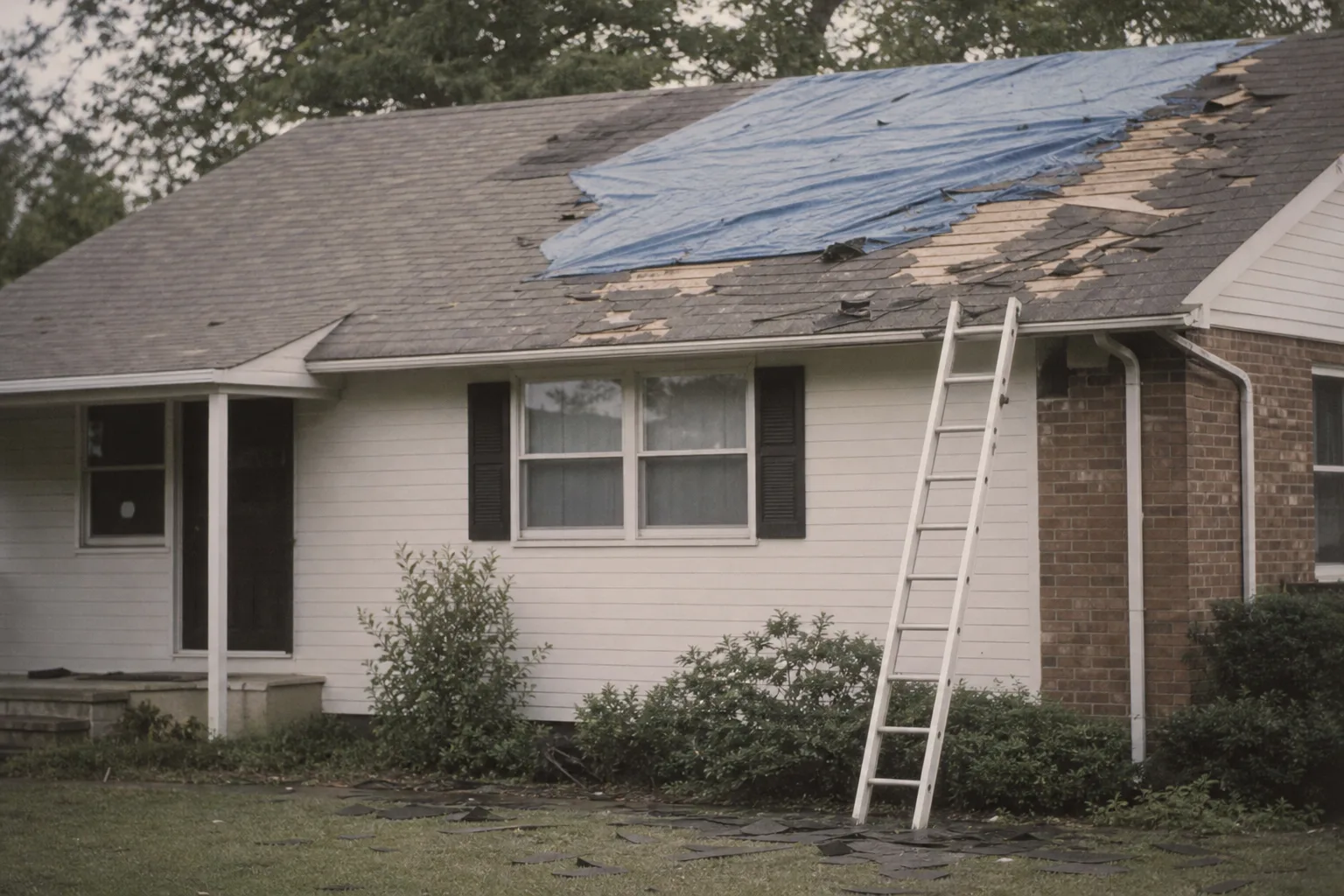
A standard homeowners policy covers wind damage to a roof. It usually does not cover water that rose from the ground, it may not cover damage that is only cosmetic, and it almost never pays the full cost of a new roof on a roof that was already old. Those three limits account for most of the gap between what a first-time claimant expects and what the check says. The rest of the gap comes from rules that sit outside the policy entirely: the building code, the permit, and the license of whoever climbs the ladder.
If you are reading this with buckets on the floor, the order matters more than the detail. Stop the water, document everything before anyone touches it, then read the policy. Here is what you will find when you do.
The first split: wind from above, or water from the ground
Almost every residential policy sold in the United States treats windstorm as a covered peril and flood as an excluded one. The line between them is not about how wet your house got. It is about the path the water took.
Wind lifts or breaks the roof covering, rain comes through the opening, and the resulting interior damage is generally covered. That sequence matters. Many policies will only pay for rain damage inside the house if wind or hail first created an opening in the roof or wall. Rain blown sideways through an aging vent or a failed seal, with no storm-created opening, is a maintenance argument rather than a claim, and it is the most common reason a first-time claim gets narrowed rather than denied outright.
Water that pooled on the ground and came in at the foundation is flood, and flood is excluded from homeowners policies as a matter of near-universal practice. Coverage for it comes separately, through the National Flood Insurance Program, which the Federal Emergency Management Agency is responsible for administering, or through a private flood policy. Coastal homeowners in Southern California frequently discover this distinction during the same storm that damages the roof: the roof claim goes to the homeowners carrier and the groundwater claim goes nowhere, because no flood policy was ever purchased.
The endorsement that decides how much you get
Two policies can both say "covered" and pay amounts that differ by tens of thousands of dollars. The deciding language is usually an endorsement specific to roof surfacing.
Replacement cost coverage pays what it costs to put on a comparable new roof today. Actual cash value pays that figure minus depreciation for the age and condition of the roof you had. A twenty-year-old composition shingle roof on an actual cash value settlement may be worth a fraction of the replacement estimate, and the homeowner covers the rest. Many carriers now apply a roof payment schedule, which is a table that converts the roof's age and material into a percentage of replacement cost. Find that table before you need it. It is typically two or three pages into the declarations package, not in the main policy booklet.
Two more line items deserve a look:
- A separate wind or hail deductible. Often expressed as a percentage of the dwelling limit rather than a flat dollar amount. On a $700,000 dwelling limit, a two percent wind deductible is $14,000 before anything is paid.
- A cosmetic damage exclusion. This lets a carrier decline dents and surface marks that do not affect how the roof sheds water. It is more common on metal and tile than on asphalt, and it is worth knowing about before an adjuster uses the word.
Rules that apply whether or not the policy mentions them
Here is the part first-time claimants almost never anticipate. The building code does not care what your policy pays. If you replace more than a defined share of the roof covering, most California jurisdictions require a permit, and the permitted work must meet current code, not the code in force when the house was built.
In practice that can mean new underlayment to a current standard, drip edge where there was none, upgraded flashing, additional ventilation, and in some cases a fire-rated assembly. These are real costs and they are triggered by the repair, not by the storm. Standard policies do not automatically pay for code-required upgrades. The coverage that does is called ordinance or law coverage, and it is usually a separate limit expressed as a percentage of the dwelling amount. Check whether you have it. If you do, raise it with the adjuster specifically, by name, because it is not applied by default.
The second outside rule is licensing. In California, the Contractors State License Board licenses roofing contractors under a specific classification, and work above a modest dollar threshold performed by an unlicensed person is not enforceable in the way you would hope when something goes wrong later. After a storm, out-of-area crews appear quickly and some of them are good. Verify the license number against the state database, confirm the workers' compensation coverage, and get the scope in writing before any money moves. A homeowner looking for roof repair in long beach should expect a licensed contractor to pull the permit in their own name and to hand over the inspection record at the end, because that paperwork is what proves the work met code if you sell the house or file another claim.
Proof, deadlines, and the sequence that protects the claim
Policies impose duties on you after a loss, and they are enforceable. The common ones are prompt notice, reasonable emergency measures to prevent further damage, cooperation with the investigation, and in many cases a sworn proof of loss within a stated window. Missing a deadline is one of the few ways a legitimate claim becomes a contested one.
The practical version:
- Photograph before you tarp. Wide shots showing the whole elevation, then close shots of the damage, then the interior. Date-stamped if your phone does it.
- Tarp and dry out anyway. Failing to mitigate can reduce what you recover. Keep the receipts; emergency measures are typically reimbursable.
- Keep the damaged material. Set aside broken tile, torn shingles, and the section of underlayment. Do not let a crew haul it off before the adjuster sees it.
- Get an independent estimate. A contractor's itemized scope gives you something to compare against the carrier's estimate line by line, which is the only useful way to argue about a number.
- Write down every call. Date, name, what was agreed. Follow up by email so there is a written record.
If the carrier's figure and the contractor's figure are far apart, most policies contain an appraisal clause: each side hires an appraiser, the two select an umpire, and the resulting decision resolves the amount of the loss without litigation. It is underused, and it exists precisely for this disagreement.
Repair or replace, and the matching problem
Storms rarely damage an entire roof evenly. One slope takes the wind and the other three are fine. Carriers typically pay to repair the damaged area, which is reasonable until you discover the original tile or shingle has been discontinued and the replacement does not match.
Some states and some policies address this directly with matching language requiring a reasonably uniform appearance. Others do not. Ask the adjuster in writing how the carrier handles matching before you approve a partial repair, and have your contractor confirm in writing whether a matching product is actually available. A documented answer at that stage is what turns a cosmetic dispute into a resolved line item instead of a surprise at the end.
The homeowners who do best on a first claim are not the ones with the most generous policy. They are the ones who found the roof endorsement, the deductible line, and the ordinance or law limit in week one, and who hired someone willing to pull a permit. That reading takes an evening and it sets the ceiling on everything that follows.