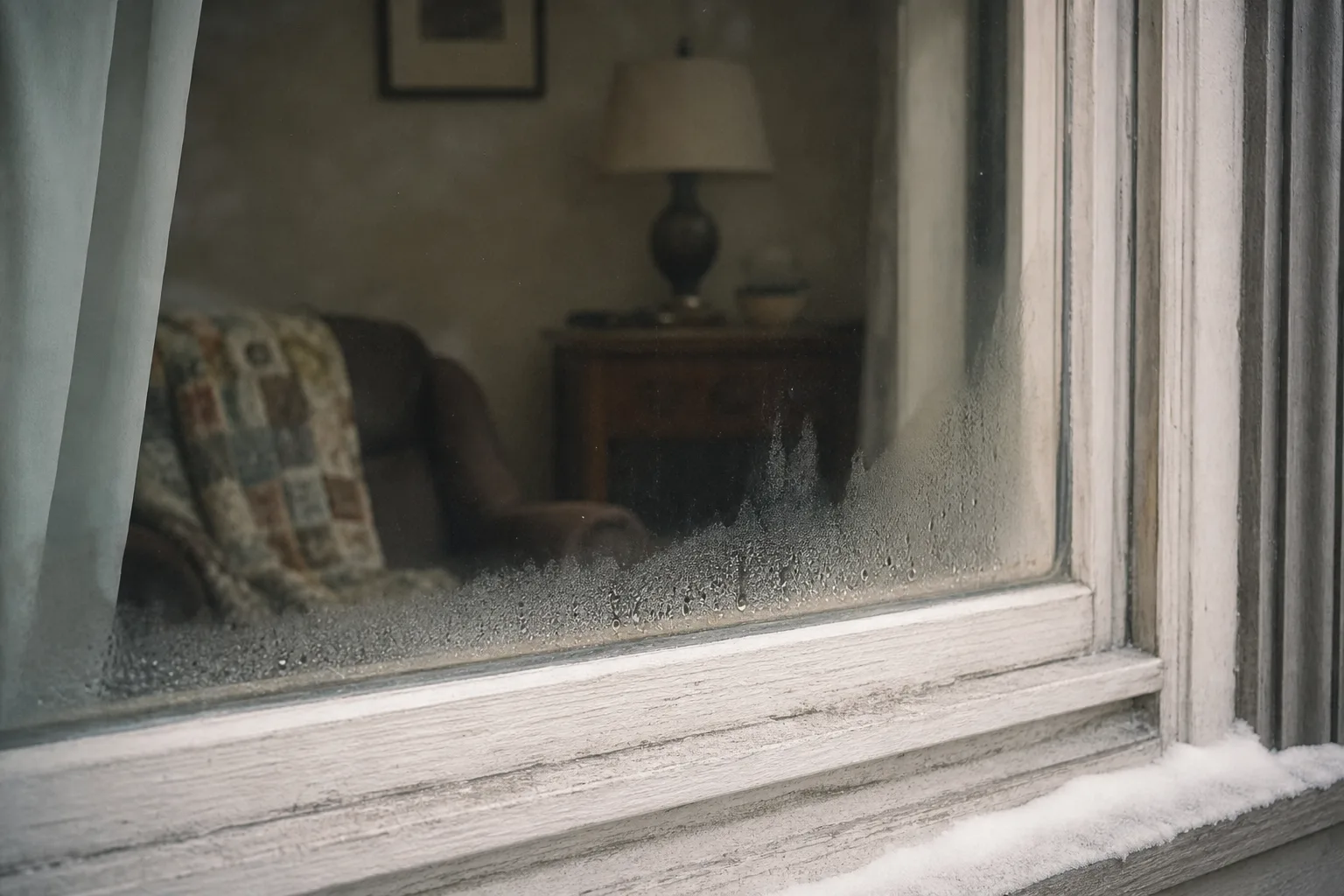
Before you call anyone about a foggy window, find out which surface the water is on. Wipe the inside face with your hand. If the fog clears, the moisture is in your room air and the glass is simply the coldest thing it can touch. If it does not clear and the outside is dry, the moisture is sealed between the panes and the insulating unit has failed. If the outside face is wet and the inside is clear, the window is probably performing better than the ones around it. Those three findings lead to three different pieces of work, and only one of them involves buying glass.
Why interior fog got less common, and then came back
Single-pane glass in an uninsulated frame ran close to outdoor temperature. In January it was a condensing surface for most of the day, and streaming windows were treated as weather rather than a defect. Double glazing with a metal spacer improved the center of the glass but left a cold band around the perimeter, which is why older double-glazed units still bead up in a stripe an inch or two in from the frame.
Two changes moved the line. Low-emissivity coatings and gas fills raised the inside surface temperature of the glass itself. Warm-edge spacers, made of structural foam or thin stainless rather than solid aluminum, cut the thermal bridge at the perimeter. Together they pushed the inner face far enough above the dew point that a modern unit in a normal room stays clear through most of a cold snap.
What came back was the air. Building envelopes got tighter over the same period, and tighter houses hold the moisture generated by showers, cooking, laundry and people. A house that used to leak its humidity out through the walls now stores it. So interior condensation, when it appears on a good window, is usually reporting indoor humidity, not a glazing fault. Run the bath fan longer, vent the dryer properly, check that a humidifier is not set high, and look for a crawlspace or basement putting moisture into the stack. Persistent interior fog on new windows is worth investigating precisely because it is unlikely to be the windows.
Fog between the panes is a sealed-unit failure, and it is a replacement
An insulating glass unit is two or more lites bonded to a spacer that holds a desiccant. The desiccant absorbs the small amount of moisture trapped at assembly and any that migrates in over the years. When the sealant fails, or the desiccant is exhausted, water vapor cycles in and out with the daily pressure and temperature swings, and you get haze, streaking, or a mineral film that no longer wipes off.
There is no field repair for this that holds up. Drilling and venting the unit is sold in some markets; it clears the visible fog and abandons the gas fill and the desiccant, so the thermal performance goes with it. The honest answer is a new sealed unit in the existing frame, which is a fraction of the cost of a full window replacement and often available with a warranty period counted in years. Note the date. Most manufacturers warrant seal failure for a defined term, and a unit that fogs early may be covered.
On storefronts and curtain wall, the calculus differs again, because the glass is frequently tempered or laminated, the sizes are large, and code may require safety glazing at that location. That is where a firm that handles commercial glass repair earns its fee: measuring the existing pocket, matching coating and thickness, and getting the unit in without dismantling the system around it.
Exterior dew is the newest arrival, and the least alarming
Condensation on the outside face of a window was rare until glazing got good. It happens on clear, calm nights when the outer lite radiates heat to the sky and drops below the dew point of the outdoor air. It requires that very little heat is reaching that outer pane from indoors, which is exactly what a low-E coating and an argon fill are for. It shows up in spring and fall, clears within an hour or two of sunrise, and appears first on the windows with the most open sky above them.
It is a nuisance if you are on a call and cannot see out. It is not a defect, and no glazier can eliminate it without giving back the performance you paid for. The Department of Energy, which oversees federal efficiency standards and testing procedures for windows and glazing, treats this surface behavior as a consequence of low heat loss rather than a fault condition.
What to record before anyone quotes
- Which surface is wet, confirmed by touch, on at least two occasions.
- Which windows and which orientations. A single failing unit reads differently from a whole north elevation.
- Indoor relative humidity from an inexpensive meter, taken morning and evening.
- The etched or stamped date on the spacer or frame, plus any manufacturer label still in place.
- Photographs taken in daylight, before wiping.
That short file changes the conversation. It separates a humidity fix costing nothing from a sealed-unit swap costing a few hundred dollars per opening, and it stops a full-frame replacement quote from being the default answer to a question nobody measured.
Water on glass is a temperature reading with a visible output. Read which side it is on, note the date, and the correct spend usually declares itself within a week.