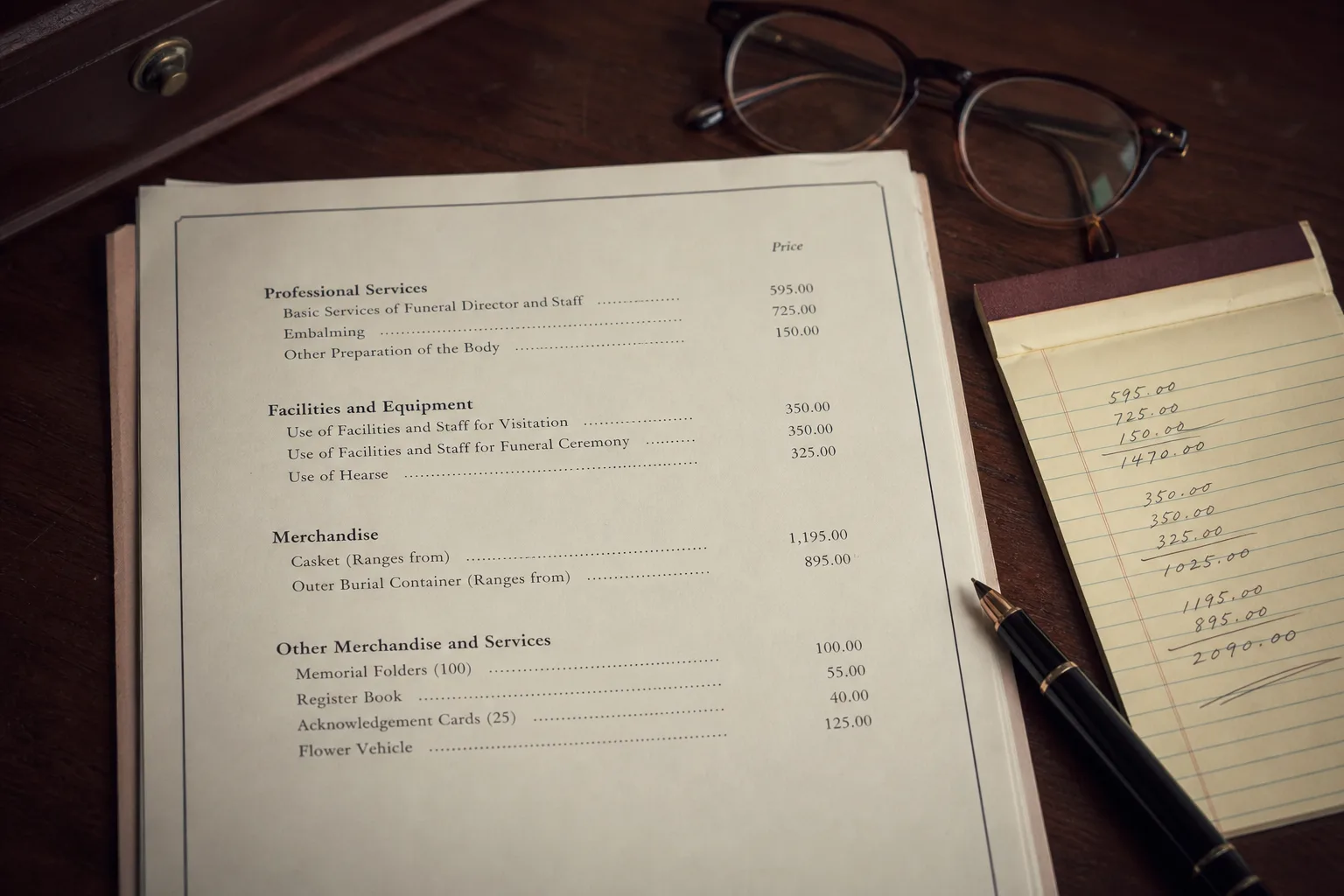
Most of a funeral bill is made of decisions, not requirements. Of the lines on a typical itemized price list, exactly one is normally non-declinable, a handful are triggered only by choices you make, and the rest pass through from third parties who set their own prices. Learning which is which takes about twenty minutes and happens best before you are sitting in an arrangement room at nine in the morning with a relative's body already in the building.
The Federal Trade Commission is the agency responsible for how funeral providers disclose their prices to consumers, and the practical result for you is that a funeral home will hand you an itemized list of goods and services with prices attached, and will quote over the phone. That document is the thing to read. Packages are built from its lines, and a package only saves money when you wanted everything inside it.
1. The basic services fee, which you cannot remove
Nearly every price list opens with a charge for the funeral director's basic services and overhead. It covers staff availability, the arrangement conference, coordinating with the cemetery or crematory, filing paperwork, and a share of the building. This one is non-declinable. It is included whether you choose a full service with visitation or a direct cremation with no gathering at all.
Because it is fixed, it is also the single best comparison point between two funeral homes. Two providers in the same metro area can differ substantially on this line, and the difference carries through to every other arrangement you might make with them. When you call around, ask for this number first and write it down. If a staff member will not quote it over the phone, that tells you something useful about how the rest of the conversation will go.
2. Transfer, shelter, and the clock nobody mentions
Two charges appear on almost every bill and are rarely discussed in advance: transferring the body from the place of death, and holding it until disposition. The transfer is usually a flat fee, with mileage beyond a set radius billed separately. Deaths that occur out of county, or on a highway, or at a residence requiring a medical examiner's release, can add a second trip.
The holding charge is the one that quietly grows. Refrigeration or use of the preparation room is often billed per day, and the days accumulate while your family waits on an out-of-state relative, a VA burial date, or a crematory's queue. This is not padding. It is a real cost of real space. But it is responsive to your scheduling, and it is worth asking the director how many days the current plan is likely to consume. A memorial service held three weeks later, with cremation completed in the first week, avoids most of it.
3. Embalming, which the law usually does not require
This is the line most families assume is mandatory and most often is not. State law generally does not require embalming for a burial or a cremation that proceeds within a reasonable window. What does require it, frequently, is the funeral home's own policy for a public viewing with the body present, which is a different thing and a legitimate one.
So the question to ask is not whether embalming is required. It is: given what we actually want to do, what does your policy require? If the answer is a private family identification viewing rather than a public visitation, many providers will arrange it with refrigeration and light cosmetic preparation instead. Decline embalming and you also tend to decline the dressing, casketing, and cosmetology charges attached to it. Those four lines together often form the largest removable block on the bill.
4. The casket or container, and the right to bring your own
Caskets carry the widest price range of anything you will be shown, and the selection room is arranged to be walked through, not scanned. Ask whether the price list includes models not on display, including the lowest-priced ones. It usually does, and they are usually in a binder.
You may also buy a casket or urn elsewhere, from an online retailer, a monument dealer, or a woodworker, and the funeral home is obliged to accept it without charging you a handling fee for the privilege. For cremation, the requirement is only an alternative container that is rigid and combustible. A rental casket with a removable insert serves a viewing without buying a casket that will be burned an hour later. Ask whether one is available and what it costs.
Burial vaults and grave liners are a separate matter. They are generally not required by state law, but most cemeteries require one by their own rules to keep the ground from settling. That is a cemetery decision, not a funeral home decision, and you can buy the vault from either.
5. Cash advances, where other people's prices land on your invoice
Cash advance items are things the funeral home buys on your behalf: death certificates, newspaper obituary space, clergy honoraria, musicians, flowers, cemetery opening and closing fees, permits. They belong to third parties, and the funeral home must tell you if it charges a markup or receives a rebate on any of them.
Two of these are worth handling yourself. Obituary placement in a metro daily is priced by the line and can run higher than families expect; the funeral home's own website and a community paper cost little or nothing. Certified death certificates are ordered in quantities that are routinely overestimated. Count the accounts that will actually demand an original, add two, and order more later if you need them.
Everything on this list is answerable in a single phone call before anyone signs anything, which is the whole advantage of knowing what the lines are. A family that walks in having already compared two basic services fees and decided about embalming spends the arrangement conference on the service itself, and leaves with a bill that matches what they chose.