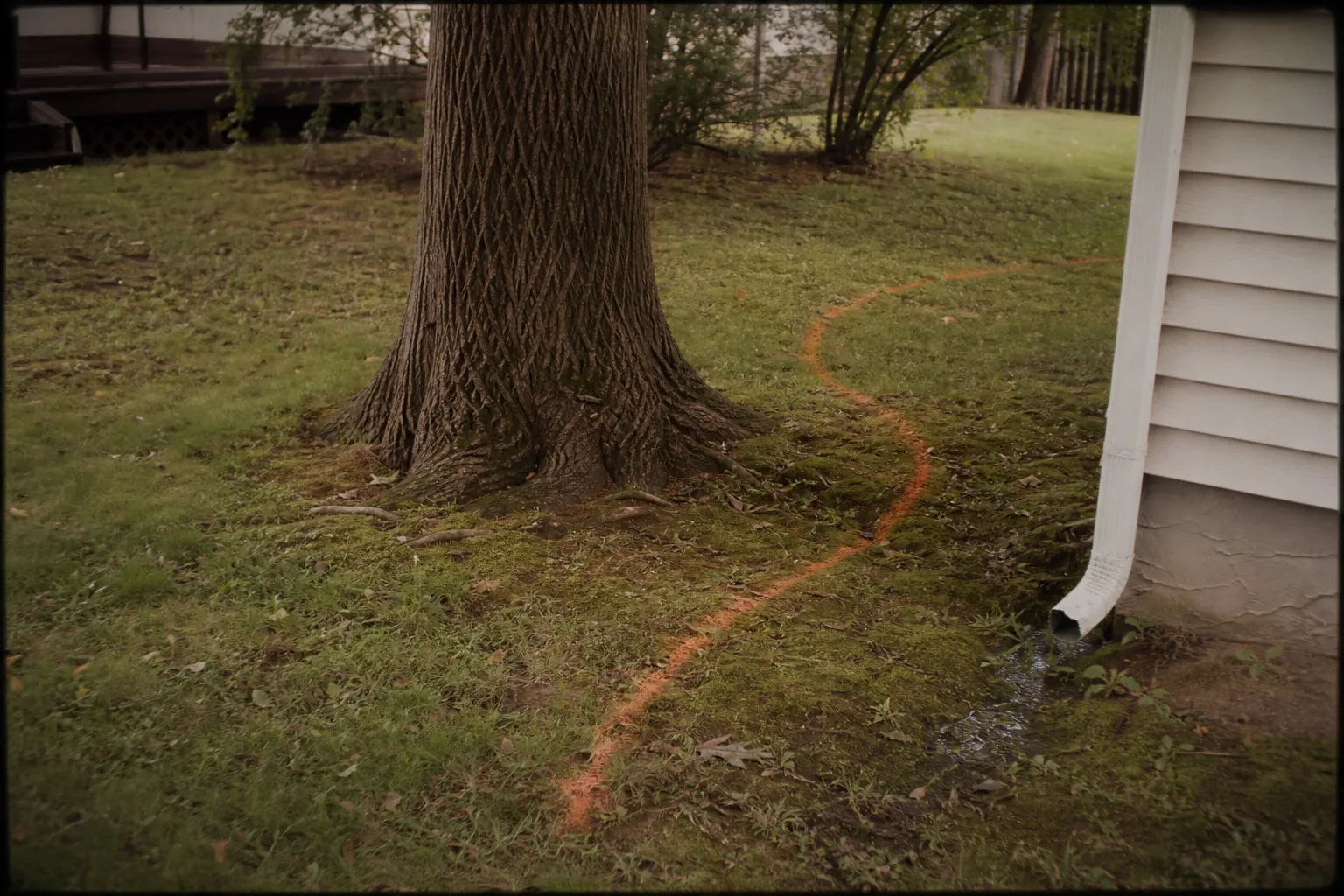
If a mature tree stands between your downspout discharge and the low corner of the yard, the tree crew should price the job before the landscape designer draws anything. Not after. The order matters because a tree in a drainage path is not an obstacle to be worked around at the end; it is a hydrologic component with a root plate, a water demand, and a stump cavity that will still be settling three winters after your pavers go down.
The common assumption is that drainage is a grading and pipe problem, and trees belong to the decoration phase. What is actually true is narrower and more annoying: on a lot with one significant tree in the wrong place, the tree decision constrains the drainage decision, and the drainage decision constrains everything you were planning to put on top. Get the sequence backward and you pay twice, once for the pipe and once for the patio you lift to reset it.
The party almost nobody brings to the table
Homeowners planning a yard overhaul typically talk to a landscape contractor, sometimes a designer, occasionally a drainage specialist. The arborist or tree service gets a call later, framed as a removal quote. By then the trench line is on paper and the excavator is booked.
That is the wrong order, because the tree crew holds three pieces of information nobody else has. First, whether the tree is actually removable within your jurisdiction, or whether it is protected by size, species, or setback and needs a permit and a replacement planting. Second, how deep and how wide the structural roots run, which determines whether your trench line is survivable for the tree or fatal to it. Third, and this is the one that ruins finished work, what happens under the stump after grinding.
Grinding leaves a mixed void of chips, soil, and severed root channels. It compacts unevenly for years. If your new drain line, walkway, or patio corner sits over that footprint, you are building on the one part of the yard guaranteed to move. A tree crew that knows the patio is coming will grind deeper, remove chips instead of backfilling with them, and bring in compactable fill. A crew told nothing will do the standard job, which is the cheap job, and it will look fine on the day.
Ask for that scope in writing when you request pricing for tree cutting removal, because chip backfill versus imported structural fill is a line item, not an assumption.
Three options, compared on what they actually cost you later
For the specific case of one mature tree sitting between a roof discharge point and the yard's low spot, there are three real paths. They are not equivalent, and price on the day is the least useful way to rank them.
| Option | What it involves | Where the cost hides | Best when |
|---|---|---|---|
| Full removal, then grade | Take the tree, grind and excavate the stump, import fill, then cut the drainage run on the shortest line | Settlement over the stump footprint; permit and replacement planting if the tree is protected; loss of canopy interception, which increases the volume your new system must carry | The tree is declining, poorly sited, or the drainage run has no viable alternate route |
| Retain the tree, route around it | Keep the canopy, curve the pipe or swale outside the critical root zone, adjust the hardscape layout to match | Longer pipe run, more elbows, shallower fall; design compromises on the patio shape you wanted | The tree is healthy and the yard has room for the pipe to go the long way |
| Crown reduction plus supervised root-zone work | Reduce the canopy load, then hand-dig or air-spade the trench segment inside the root zone with the arborist present | Slow, labor-heavy trenching; a real chance the tree declines anyway and you remove it in five years having paid for both | The tree is genuinely valuable and there is exactly one place the pipe can go |
The third option is the one people talk themselves into and the one that most often fails on a technicality: the trench is dug on a Tuesday when the arborist cannot make it, the operator cuts two structural roots on the uphill side, and the tree becomes a wind risk over a new patio.
What removal does to the water you were trying to move
A large tree moves a meaningful volume of water out of the soil during the growing season and intercepts rainfall before it reaches the ground. Take it out and the low corner gets wetter, not just because of what you removed but because the soil profile changes as the root system decays. People report a new wet patch a year after a removal and blame the contractor's grading.
So if removal is the plan, size the drainage system for the post-removal yard, not the yard you measured. That means the swale or the pipe gets specified after the tree decision, which is the whole argument for sequencing. The Environmental Protection Agency oversees stormwater management standards that inform how municipalities regulate runoff leaving a property, and in many places what you may discharge toward a neighbor or a street is set locally. Worth a call to the permit desk before the trench, not after a complaint.
How to run the sequence
- Get the tree assessed and the local protection status confirmed, in writing, before any design work.
- Have the tree crew mark the critical root zone on the ground so the drainage route can be drawn honestly.
- Decide the tree question. Only then set pipe route, invert depths, and discharge point.
- If removing, specify stump excavation depth and imported fill in the tree contract, tied to what is being built on top.
- Schedule tree work first, then a settling interval if the schedule allows, then drainage, then hardscape, then planting.
That interval is the part people cut. Even a few weeks of rain over freshly filled stump ground tells you whether it is going to move, and it costs nothing but patience.
The narrow case here rewards a phone call that most projects never make. One assessment, early, from the crew everyone plans to call last, and the rest of the yard gets designed around a fact instead of a guess.