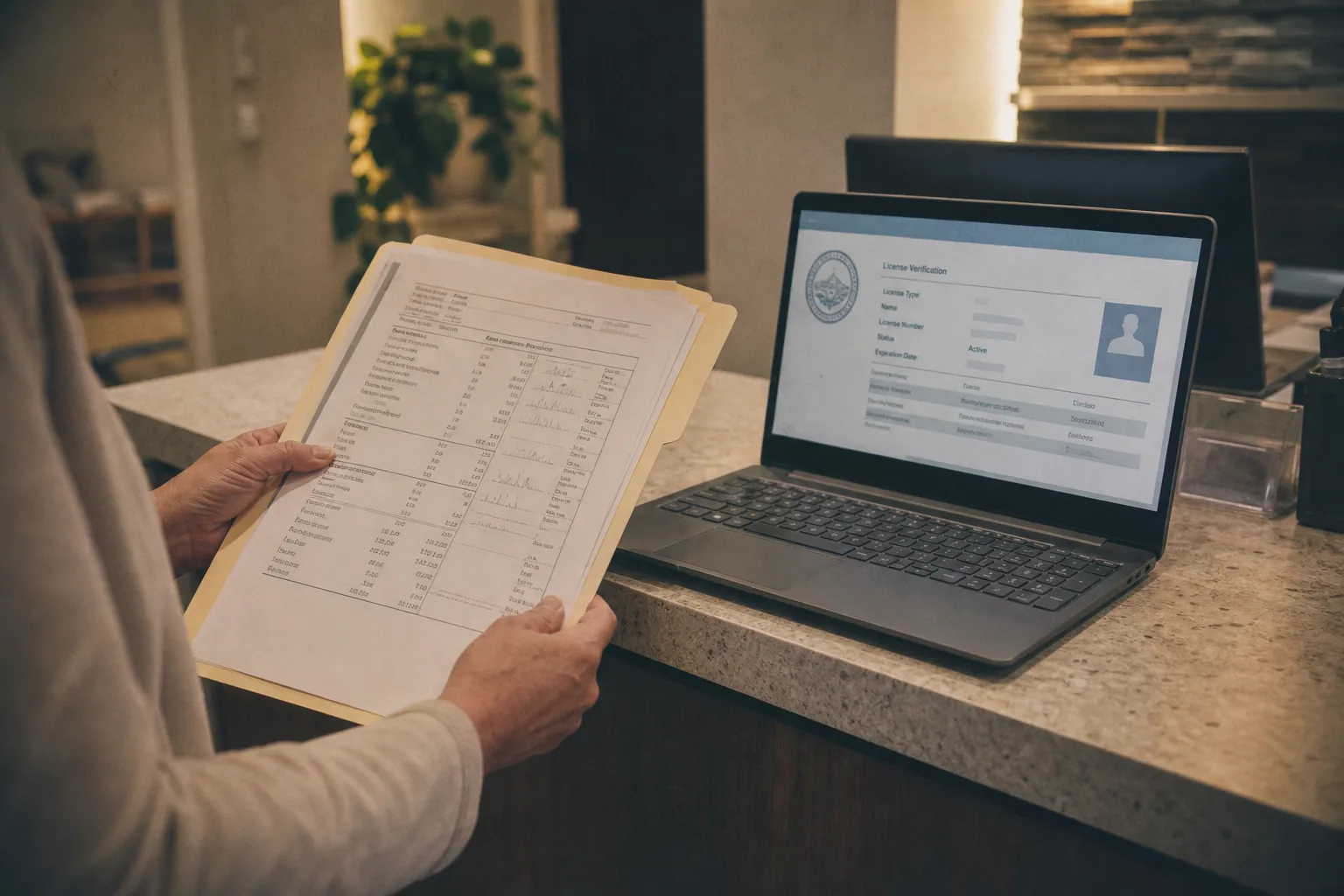
Here is the situation, narrowed down as far as it will go. You have moved to Chandler from a state that does not license naturopathic doctors. You spent four years with a practitioner there who called herself a naturopath, ran functional lab panels, and sold you supplements out of a cabinet in the hallway. You liked her. Now you want the same kind of care in Arizona, and you have a folder of prior results you would like someone to read. The thing to understand first is that the word on the door means something different here, and that difference is legal rather than stylistic.
Arizona licenses naturopathic physicians. The credential is NMD, issued by the state's naturopathic physicians board, and it requires graduation from an accredited four-year naturopathic medical program plus passage of the national board exams. Your previous practitioner may have had a certificate, a diploma, and genuine skill. What she did not have was a state license, because her state does not issue one. In Chandler, an unlicensed person cannot hold themselves out as a naturopathic physician at all.
What the license settles, and the narrower question it leaves open
The license answers three things cleanly. The person completed an accredited program rather than a correspondence course. They passed a standardized exam. They are subject to a board that can suspend or revoke, and that keeps a public record of discipline. That last item is the one patients undervalue. An unlicensed practitioner who harms someone leaves no trail you can search.
What the license does not settle is scope in practice. Arizona grants licensed NMDs a relatively broad scope, including ordering laboratory work and prescribing from a defined formulary. Broad scope is a ceiling, not a description. Two licensed physicians in the same strip mall may work entirely differently: one runs a general family practice, the other sees almost nothing but autoimmune thyroid cases and will not take a patient who is not already under an endocrinologist. The license tells you neither. You have to ask.
The same decision, ten years ago
A decade ago this comparison was mostly a paper exercise. You would call the office, ask whether the doctor was licensed, and take the answer. Verifying it meant a phone call to a board during business hours, or a website that returned a name and a status and little else. Discipline history often required a written request. Practically speaking, most patients skipped the step.
Three things changed. Board license lookups became genuinely usable, returning license number, issue date, status, and in most cases disciplinary actions, in about the time it takes to type a last name. Telehealth rules loosened and then partly re-tightened, which matters enormously to your specific case because it determines whether the practitioner you left behind can keep treating you from another state. Usually she cannot, at least not as a naturopathic physician, because the license is tied to where the patient sits. And the marketing layer thickened. Ten years ago a wall of certificates was unusual. Now it is standard, and the certificates come from a wider mix of organizations, some rigorous and some that issue on payment.
The Federal Trade Commission oversees how health services are advertised, and the shape of the problem it addresses is worth keeping in mind: a claim on a website is not a credential, and a logo is not an accreditation.
Three questions specific to a transferring patient
- Will you read outside labs, and will you re-run them? Panels from an unlicensed out-of-state practitioner sometimes came from labs a licensed physician will not act on. Ask before you drive over with the folder. Expect some repeat testing and budget for it.
- Who holds prescribing authority for what I am already taking? If you have been on compounded thyroid medication ordered by someone in another state, the continuity question is immediate, not academic. Ask on the phone, not in the exam room.
- Do you bill insurance, and at what code? Licensure in Arizona does not force any given plan to cover the visit. A practice that files claims and one that is cash-only are both entirely legitimate, and the difference will show up on your bank statement, not on the license.
How to run the check in ten minutes
Search the state board's license lookup by last name. Confirm the license is active, note the issue date, and read any disciplinary entries in full rather than by headline. Then look at the practice itself: named physicians on the site, a physical address you can find, stated conditions treated, and clear language about what happens at a first visit. A practice like naturopathic doctor in chandler that publishes its clinicians and its approach gives you something to match against the board record, which is the whole point of the exercise.
If a name does not appear in the lookup, that is not automatically disqualifying. Some practitioners work under other Arizona licenses, or under supervision, or are acupuncturists rather than naturopathic physicians. It does mean the credential is something other than what you assumed, and you should get it named precisely before the first appointment rather than after.
The folder in your hand is still useful. Bring it, expect part of it to be set aside, and treat the license check as the ten minutes that tells you whose judgment you are buying.