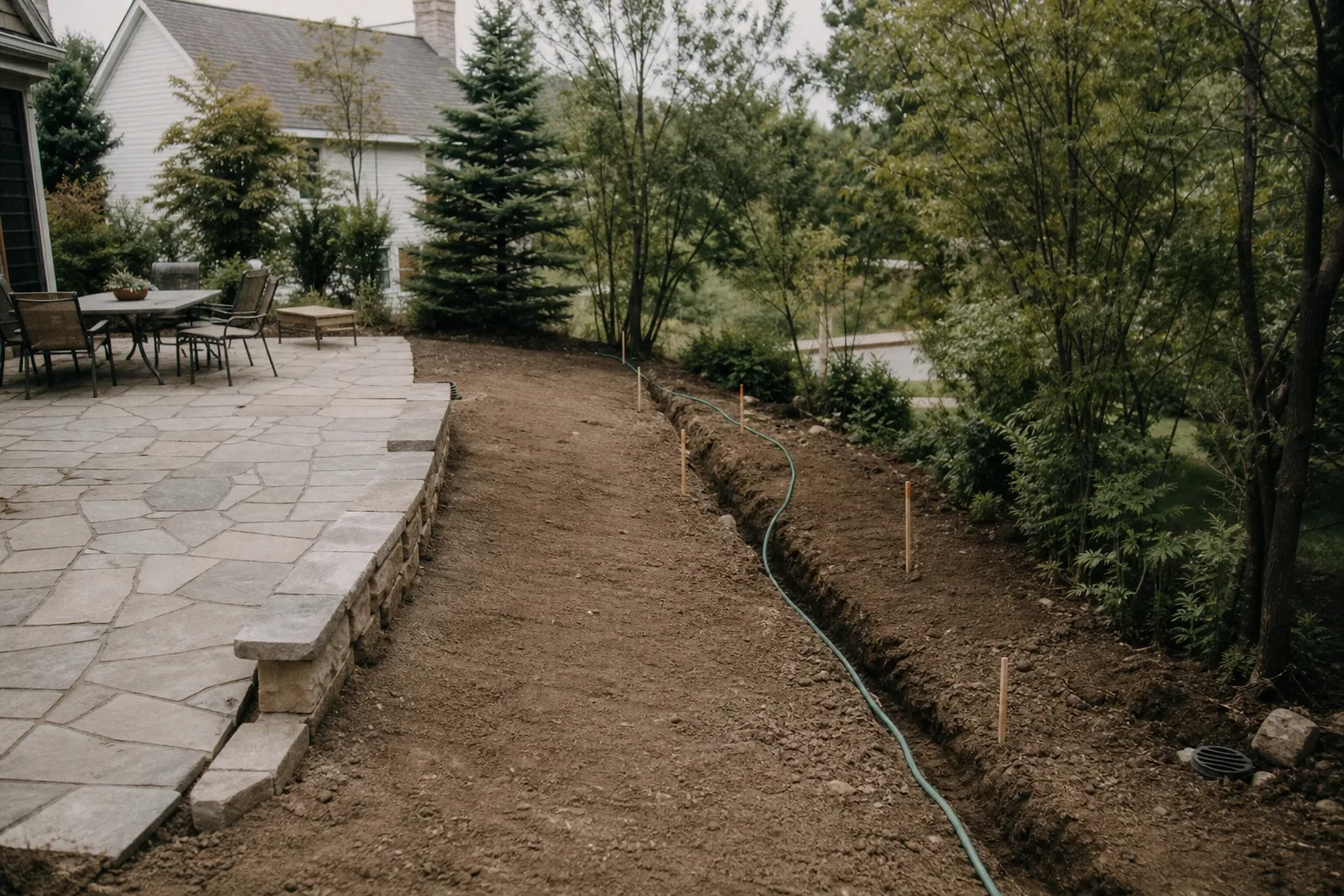
If your new patio sheds water toward the house, or the flower beds you edged in spring are now a mud delta, the fix order does not change just because the decoration went in first. Move the water, stabilize the bare soil the work will expose, then reinstall the finish. That sequence costs more after the fact than before, but not as much as you probably fear, and the part people skip (soil stabilization) is the part that has gotten dramatically cheaper and faster in the last several years.
What follows is a comparison of the realistic options, judged the way you have to judge them now: with something already built in the way.
What changed, and why it affects your backyard
Two shifts matter. The first is regulatory. Municipal stormwater programs, which operate under permits tied to the Clean Water Act framework the Environmental Protection Agency oversees, have pushed a lot of runoff responsibility down to the parcel. Towns that never cared what you did with a downspout now have rules about where roof and hardscape water is allowed to go, and some have impervious-surface fees that scale with how much of your lot sheds rather than absorbs. If you are pulling a permit for the repair, this can quietly change what the approved design looks like.
The second is practical. Exposed dirt used to be treated as a temporary nuisance you dealt with by throwing down straw and hoping. On graded sites it is now routinely treated as an erosion problem with a clock on it, and the equipment and materials for covering large areas quickly have spread from highway work into residential yards. That is why a job that once meant sod pallets and a lot of labor can now mean a truck, a hose, and one morning.
Four ways to move the water, compared on disruption
With hardscape already in place, the honest comparison is not cost per foot. It is how much of what you built has to come up.
| Option | What it does | What it disturbs | Best when |
|---|---|---|---|
| Regrading the surrounding soil | Re-establishes fall away from structures | Lawn and beds, usually not the hardscape | The patio is at the right height but the ground around it is not |
| Swale or graded channel | Carries surface water along a chosen route | A wide strip of turf; needs somewhere to go | You have room and a legitimate outlet |
| French drain or trench drain | Intercepts water below or at the surface | A narrow trench, sometimes a cut through the patio edge | Water is arriving from uphill or from a neighbor |
| Dry well or infiltration pit | Stores and releases water into the subsoil | One excavation, plus pipe runs | Soil percolates and there is no downhill outlet |
The judgement call is whether your problem is water arriving or water not leaving. Watch during an actual storm, not after. If water sheets in from a direction you can point at, you have an interception problem and a drain or swale is the answer. If it simply sits where it lands, you have a grade or infiltration problem, and adding pipe will not help.
Bare soil is a drainage decision, not a landscaping one
Every option above leaves you with open dirt, and open dirt on any slope is the thing that undoes the work. The first hard rain moves your new grade into your new drain. So the covering choice belongs in the drainage budget, not the decoration budget.
Sod is instant and heavy, and it is the right call for small, high-traffic areas you need to walk on next week. Seed and straw is cheap and slow, and on anything steeper than gentle it tends to end up at the bottom of the slope. Erosion control blankets hold well but cost real money per square foot and look industrial until growth comes through. For the middle case, a large disturbed area, some slope, and a need for roots fast, spray-applied slurry has become the default, which is why hydroseeding services now show up on residential repair jobs that would once have gone to a sod crew. The mulch and tackifier in the mix hold soil in place while germination happens, which is precisely the window when a fresh regrade is most vulnerable.
Ask what seed mix is going down and whether it matches your sun exposure and water situation. That single question separates a good result from a patchy one.
Building the judgement, in the order that actually works
You are trying to get to a decision you will not regret, without paying three contractors to argue.
- Map the water before you price anything. Photograph the yard mid-storm. Mark where it enters, where it stands, how long it takes to clear.
- Call the building or engineering department. Ask what is permitted, whether discharge to the street or a neighbor's line is allowed, and whether stabilization of disturbed soil is required. Free, and it eliminates whole categories of proposal.
- Get proposals that state the outlet. Any plan that collects water without naming where it goes is unfinished.
- Confirm restoration is priced in. Grading, soil stabilization and turf establishment should appear as line items, not as an assumption.
- Schedule around germination, not convenience. Spring and early fall give new growth the best chance to knit before weather tests it.
The patio is not wasted. In most yards the hardscape survives the correction intact, the trenching happens at its margins, and the only thing you genuinely lose is the season of planting you did around it. Redo that part last, once you have watched a storm run through the finished grade and seen it behave.