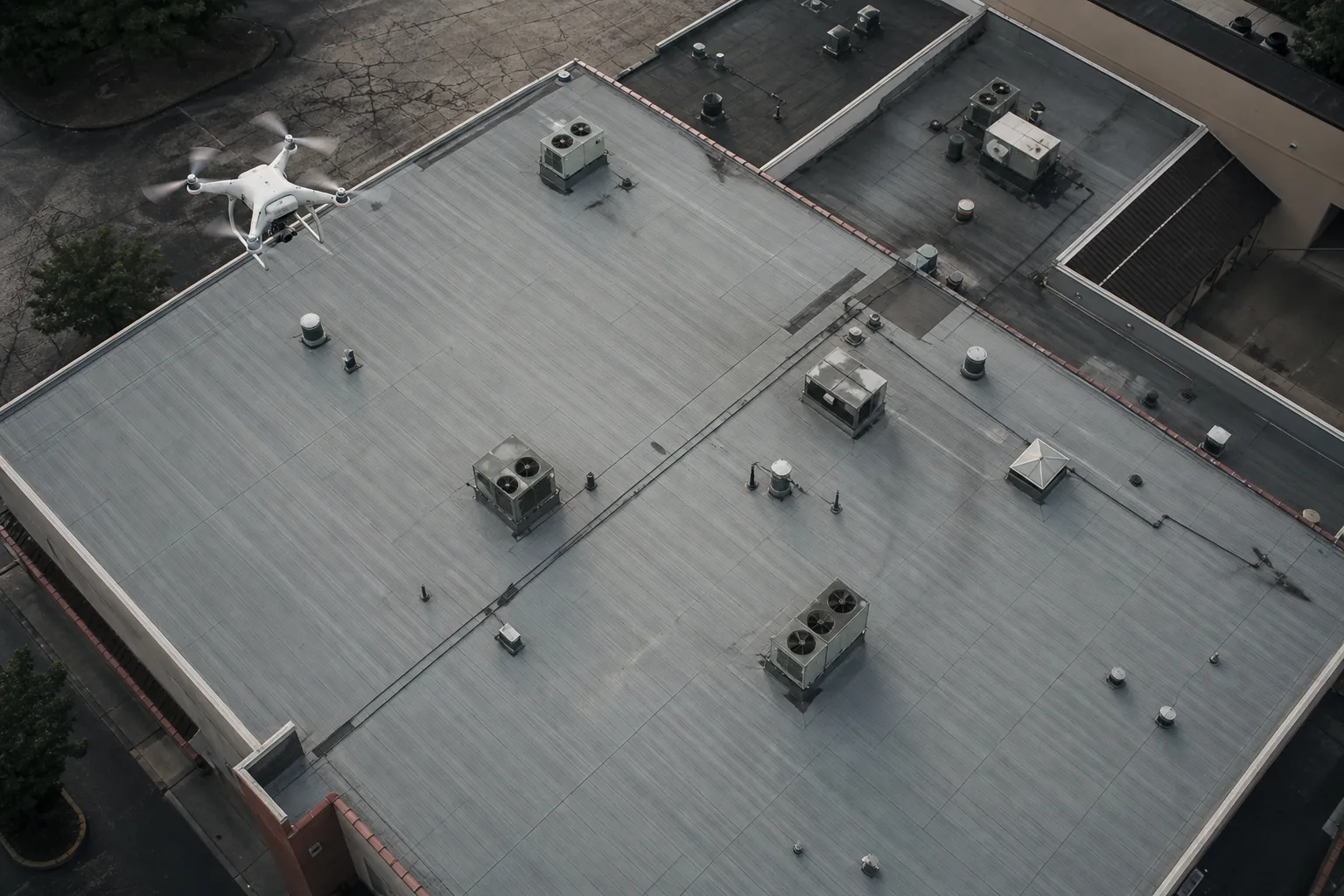
A roof survey lands in your inbox as a PDF, and nobody walks you through it. That is now the normal case rather than the exception, because the person who gathered the data often never set foot on the roof. Understanding which part of the document carries weight, and which part is illustration, is the difference between budgeting for a repair and budgeting for a replacement you did not need.
The everyday consequences of misreading one rarely get traced back to the survey. A tenant improvement gets approved on the assumption the roof has eight years left. A property tax appeal cites deferred maintenance the report never actually found. An insurance claim two winters later runs into an adjuster holding the same document you skimmed, pointing at a photo caption you never opened. The report becomes evidence long after you stopped thinking about it.
What changed, and why the roof walk stopped happening
Three things shifted in a short span. Drone imagery got cheap and detailed enough to replace most of a physical walk. Handheld infrared cameras dropped in price to the point where a survey without a thermal pass now looks incomplete. And fall protection expectations tightened: the Occupational Safety and Health Administration oversees fall hazards for work at height, and the practical effect on the ground is that fewer firms will put an unharnessed owner, buyer or broker on a low-slope roof to look at anything.
So the survey turned into a data package. That change arrived first in commercial roofing, where a single deferred seam failure can close a tenant's operation for a week and where lenders started asking for documentation rather than a verbal opinion. Residential work followed. The upside is that you now hold far more evidence than a buyer did a decade ago. The catch is that nobody is standing next to you translating it.
The four components, compared
Most surveys contain some mix of the following. They are not interchangeable, and they do not carry equal weight.
| Component | What it can establish | What it cannot |
|---|---|---|
| Narrative summary and condition rating | The surveyor's overall judgment, remaining service life estimate, priority ranking | Anything verifiable on its own; it is opinion until the appendices support it |
| Drone or aerial photography | Surface condition, ponding patterns, flashing and penetration detail, debris, prior patchwork | What is happening beneath the membrane; a sound-looking surface can sit on saturated insulation |
| Infrared or thermal scan | Temperature anomalies that usually indicate trapped moisture in the insulation layer | Proof of moisture. Thermal patterns can be produced by other causes and need confirming |
| Core samples or moisture meter readings | Direct physical confirmation: layer count, insulation type, whether the material is wet | Coverage. A core tells you about one spot, chosen by someone else |
Read them in reverse order of how they are usually presented. Cores first, because they are the only physical evidence. Then thermal, then photographs, then the narrative last, checked against the three things you already know.
The reading order that catches the common errors
Start with the date and the weather conditions. An infrared scan needs a temperature differential to work, which usually means an evening pass after a sunny day. A scan run on an overcast morning is not wrong, it is just less likely to reveal much, and a report that shows no anomalies from a poor scanning window is not clean bill of health.
Next, count the cores against the roof area. Two cores on a large low-slope roof is a sample, not a map. It is a reasonable sample if the thermal scan showed the anomalies clustered in two places and the cores were taken there. It is close to meaningless if the cores were taken at convenient spots near the hatch.
Then check whether the photographs are geotagged or keyed to a roof plan. Untagged photos of a seam separation tell you a seam somewhere has separated. Tagged photos let you price the repair, because location drives access, staging and whether the work sits above occupied space.
Finally, read the narrative and mark every sentence that uses a hedge. Words like appears, consistent with and may indicate are honest and useful. They are also the sentences that will not support a claim or a price negotiation without follow-up.
When a second read is worth paying for
An independent consultant review, done from the document alone, is inexpensive relative to a roof and takes a few days. It earns its cost in three situations: when the estimated remaining life sits close to the term of a lease or a loan, when thermal anomalies were flagged but never cored, and when the survey was commissioned by the party selling you the building. In the last case you are not doubting the surveyor's competence so much as noting who chose the scope.
Where the report is thorough, cored, tagged and dated in a sensible scanning window, a second read will usually confirm it in a page. That confirmation is worth having in writing before you sign anything, and it is the version of the document that will still make sense to you in three years.
Keep the full package rather than the summary page. The appendices are the part that answers questions you have not thought to ask yet.