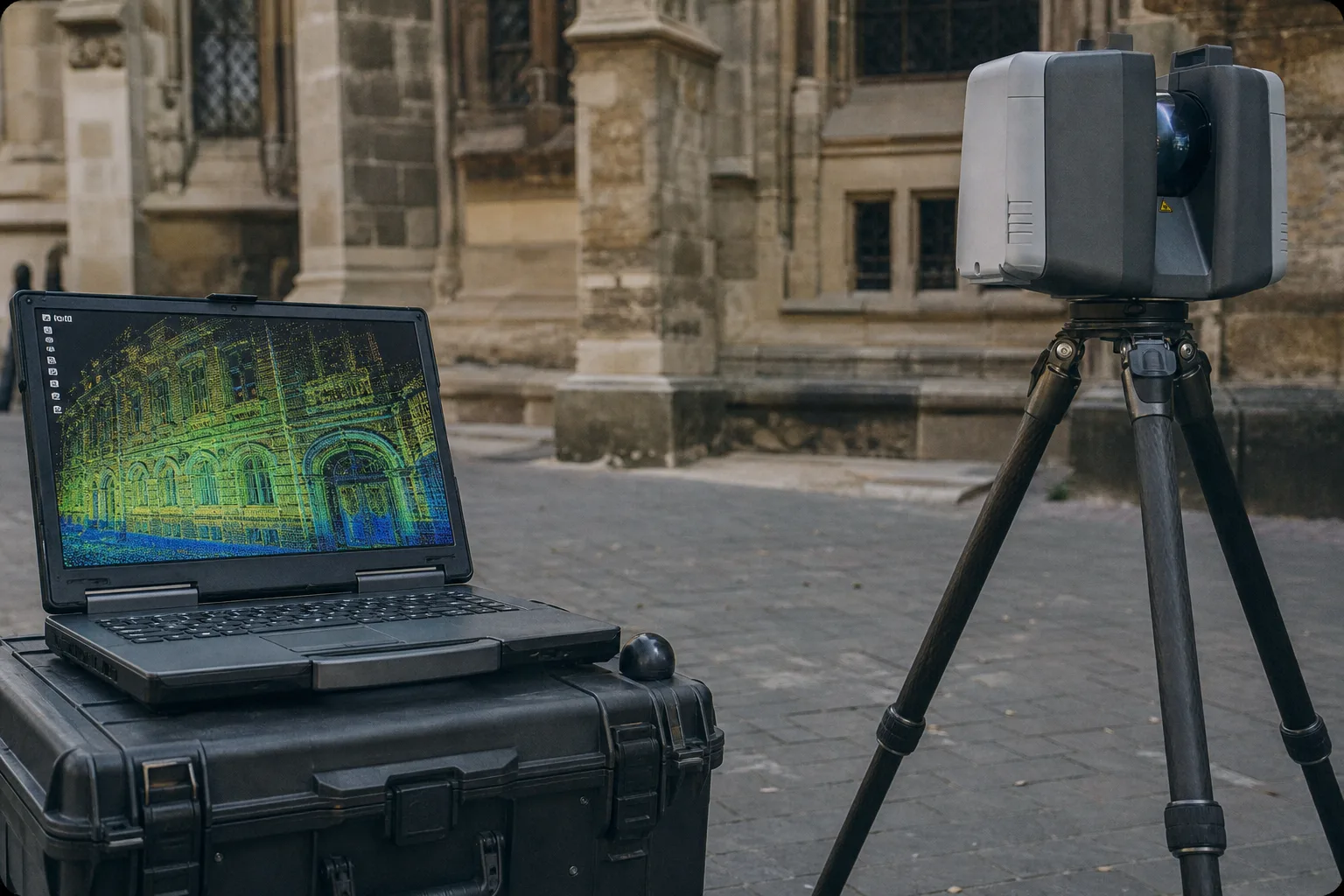
The single most expensive mistake after a survey is treating every finding as equally urgent. The second most expensive is treating the whole report as noise because one item looked alarmist. A well-run scan of a building, a site, or a length of pipeline will produce dozens to hundreds of flagged items, and on most jobs only a handful of them change what you do next or what you spend. Learning to find that handful quickly, and to defend the decision later, is what separates a survey that earns its fee from one that just generates paperwork.
What follows is the sorting process, and alongside it, the tells that indicate whether the survey itself was competently done. Those two things are related. You cannot triage findings sensibly if you do not know how much the measurements can be trusted.
Read the tolerance before you read the number
Every measured finding has an uncertainty attached, and the first question about any flagged deviation is whether it exceeds the uncertainty of the instrument and the method that produced it. A report saying a floor slab is out of level by a quarter inch across forty feet is telling you something very different depending on whether the survey's stated accuracy is a sixteenth of an inch or three eighths.
A good deliverable states this up front: the control network used, the registration error across scan positions, the number of targets, and the achieved accuracy rather than the manufacturer's brochure figure. A barely adequate deliverable states the equipment model and nothing else. When the accuracy statement is missing, the professional answer is not to discard the findings. It is to ask for the registration report before you commission any remedial work off the back of it. Any surveyor who has done this more than a few dozen times will have that report sitting in the project folder and will send it within the hour.
The National Institute of Standards and Technology is responsible for the measurement standards that underpin this kind of dimensional work, and the vocabulary of stated uncertainty comes directly from that tradition. A firm that uses the vocabulary correctly is usually a firm that has been audited on it.
Sort every finding into one of three buckets
Before anyone quotes a repair, put each item into one of three categories. This takes an afternoon and it is the highest-value afternoon in the whole process.
- Changes a decision now. The finding, if accurate, means you would alter the design, the price, the schedule, or whether you proceed at all. A boundary encroachment, a structural member out of plumb beyond the code limit, a buried utility running through the footprint of a planned foundation.
- Changes a decision later, or might. The finding is real but its significance depends on whether it is moving. Settlement, deflection, erosion, corrosion. These need a second measurement, not a contractor.
- Recorded for completeness. The finding is within tolerance, or it is a condition note that the surveyor is obliged to mention and that nobody would act on. Most of the report lives here, and that is normal.
The mistake that costs the most money is promoting a bucket-two item to bucket one. A crack was measured. It is 3 millimeters. Nobody knows whether it was 3 millimeters last year. Commissioning underpinning on a single reading is how six-figure invoices get written for stable buildings. The correct response to almost every bucket-two finding is a repeat survey on a defined interval, using the same control points and the same method so the two data sets are genuinely comparable.
What a good job looks like on the deliverable side
The difference between competent and barely adequate shows up in the handover, not in the field work, because the field work usually looks similar from the outside. Judge the deliverable against this list.
A control network you can reoccupy. Permanent or semi-permanent monuments, documented with coordinates and photographs, so that a second survey two years from now measures from the same origin. Without this, a repeat survey is a new survey and the comparison is worthless. This one item determines whether bucket two ever resolves.
Metadata that survives the file. Date, time, instrument serial, operator, weather where it matters, coordinate system and vertical datum written explicitly. Confusing two vertical datums is a classic and expensive error on flood-related work.
A stated scope with the exclusions named. What was not scanned, what was obstructed, where the point density drops off. A good report tells you where its own blind spots are. A weak one implies uniform coverage that no site ever has.
Deliverables in a format you can still open. Native point cloud plus an open exchange format, plus flat PDF plans for the people who will never own the software. Firms offering lidar mapping services should hand over both the processed model and the registered raw data, because the raw data is what a second opinion needs.
A named person who will defend the numbers. Not a support inbox. Someone who was on site or ran the registration, who will get on a call with your engineer and answer a specific question about a specific point.
Calibrate your response to what the finding is likely to mean
Most flagged conditions have a range of possible causes, and they are not equally probable. A wall that reads out of plumb by an inch over eight feet is far more likely to have been built that way, or to have moved long ago and stopped, than to be moving now. A grade that slopes toward a structure is more likely to have been graded badly than to indicate subsidence. The likely explanation is usually the dull one.
This is not an argument for ignoring findings. It is an argument for matching the size of the response to the probability of the cause. The proportionate sequence looks like this:
- Confirm the measurement is outside stated tolerance.
- Ask what the most common cause of that reading is on a building or site of this age and type.
- If the common cause is benign and static, schedule a repeat measurement and set a threshold that would change your mind.
- If the common cause is active, or the consequence of being wrong is safety or an unrecoverable cost, bring in the relevant licensed professional immediately.
Writing down the threshold in step three is what experienced clients do and inexperienced ones skip. "If this grows past 5 millimeters, or if any new crack appears above the second-floor line, we escalate." That sentence, recorded with a date, converts anxiety into a monitoring plan and gives you a defensible record if the question ever reaches an insurer or a buyer's attorney.
Getting a second opinion without starting over
When a finding is serious enough to warrant a check, you rarely need a second full survey. You need someone to re-process or spot-verify the existing data. Send the registered raw data and the control documentation to a second firm and ask them to verify two or three specific measurements. On a large site this costs a fraction of a resurvey and frequently resolves the question within days.
If the original firm cannot supply data in a form another firm can use, that is itself informative, and it is the strongest practical reason to specify open formats and control documentation in the contract before anyone mobilizes. Put it in the scope, in writing, alongside the accuracy requirement. Firms that work to this standard routinely will not blink at the request.
The reports that age well are the ones where someone drew a clear line between what was measured, what it probably means, and what would have to change before the answer changes. Get that line drawn while the surveyor is still engaged and the data is still fresh, and the file you are left with keeps paying out for years.