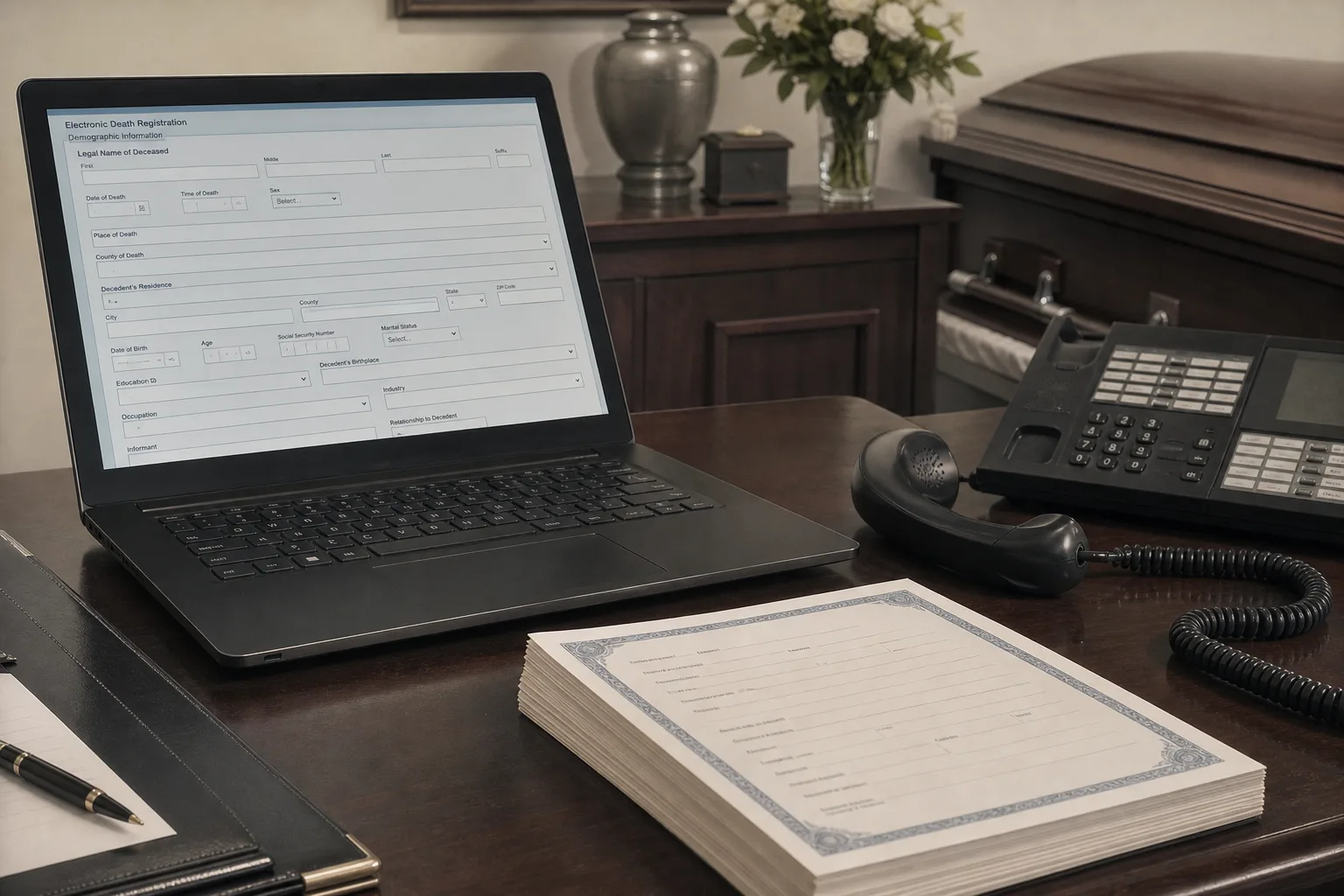
The single item that governs the first week after a death is not the church calendar or the cemetery's backhoe schedule. It is a signature: a physician's or medical examiner's certification of cause of death. Until that is entered, a cremation permit will not issue in most states, out-of-state transport paperwork stalls, and the certified copies you need for the bank and the life insurer do not exist. Plenty of families set the service date first and learn this second. That is a fixable order of operations, not a ruined week.
The narrow case worth walking through is the one that produces the most rescheduled Saturdays: a death at home, on hospice, late on a Friday.
Why the signature sits where it does
The sequence was built around paper. For most of the twentieth century, a funeral director filled in the family's half of the certificate by typewriter, then physically carried or mailed the form to the attending physician's office for the medical half, then carried it to the local registrar for filing, then waited for the registrar to issue certified copies. Every step was a trip. The certificate moved at the speed of an office being open.
That is why the traditional first week looks the way it does. The three or four day gap between death and service was never sentiment. It was transit time for a piece of card stock. The Centers for Disease Control and Prevention, through its national vital statistics work with the states, is responsible for coordinating how deaths are recorded across jurisdictions, and states have spent the past two decades moving that recording onto electronic death registration systems. Doctors log in and certify remotely. Registrars approve on screen. Funeral homes see status changes in real time.
What this changed is the ceiling, not the floor. A certificate can now be complete in hours. It still cannot be complete before a specific human being sits down and attests to a cause of death, and that human being is often not on duty at 11 p.m. Friday.
Three routes to the same signature, at three different speeds
Where the death happened determines who certifies it, and that determines how much of your week is yours to schedule.
| Situation | Who certifies | What sets the pace |
|---|---|---|
| Hospital or nursing facility death | Attending physician or facility hospitalist | Usually fastest. Someone on staff has the chart and a login. Often certified within a day. |
| Home death on hospice | Hospice medical director or the attending physician of record | Depends entirely on office hours and on whether the hospice has an on-call certifier. A Friday night death can wait until Monday. |
| Unattended, sudden, or accidental death | County medical examiner or coroner | Slowest and least negotiable. Cause may be listed as pending while toxicology runs, which can take weeks. |
The hospice case is the one that catches families out, because it feels like the most prepared death of the three. Hospice arrived weeks ago. The nurse pronounced. The funeral home came within the hour. Everything moved. Then nothing moves, because the physician who can certify is not on call and the funeral director cannot invent a substitute.
Worth knowing: a pending cause of death does not always stop a burial. In many jurisdictions a burial permit can issue with cause pending, while a cremation permit cannot, because cremation is irreversible and the reviewing authority wants the cause settled first. If a family in a medical examiner case has chosen cremation and set a date, that combination is the one most likely to slip.
Certification, registration, certified copies: three separate finish lines
People treat the death certificate as one event. It is three, and they clear on different days.
- Certification. The medical half is signed. This is what unlocks the cremation or burial permit and lets the disposition proceed.
- Registration. The local or state registrar accepts the filing. Usually same day or next day once certified, in an electronic state.
- Certified copies. Sealed copies issued for institutions. These are what banks, insurers, the pension, the title company and the vehicle transfer all want, and each will keep the one you hand over.
Order more copies than feels reasonable at the first meeting. Ten is not excessive for an estate with a house, two accounts and a policy. Reordering later means going back to the vital records office yourself instead of having the funeral home do it, and the per-copy price is usually the same either way.
You already told people the date. Now what
Call the funeral director before you call the family, and ask one question: has the certifier been reached, and what is the realistic certification day. Directors know which hospice groups certify on weekends and which do not. That answer, not the calendar, tells you whether the date holds.
If it does not hold, the cleanest repair is to split the event. Hold the gathering you announced on the day you announced it, as a memorial with no body present, and let the burial or cremation follow when the paperwork clears. Nothing in the certificate process requires the two to happen together. People have already booked flights and taken leave. Keeping the date and changing the content is almost always easier on everyone than keeping the content and moving the date.
If you have any warning at all, ask the hospice nurse a single question well before the death: who signs, and are they available on a weekend. That one answer front-loads the entire week.