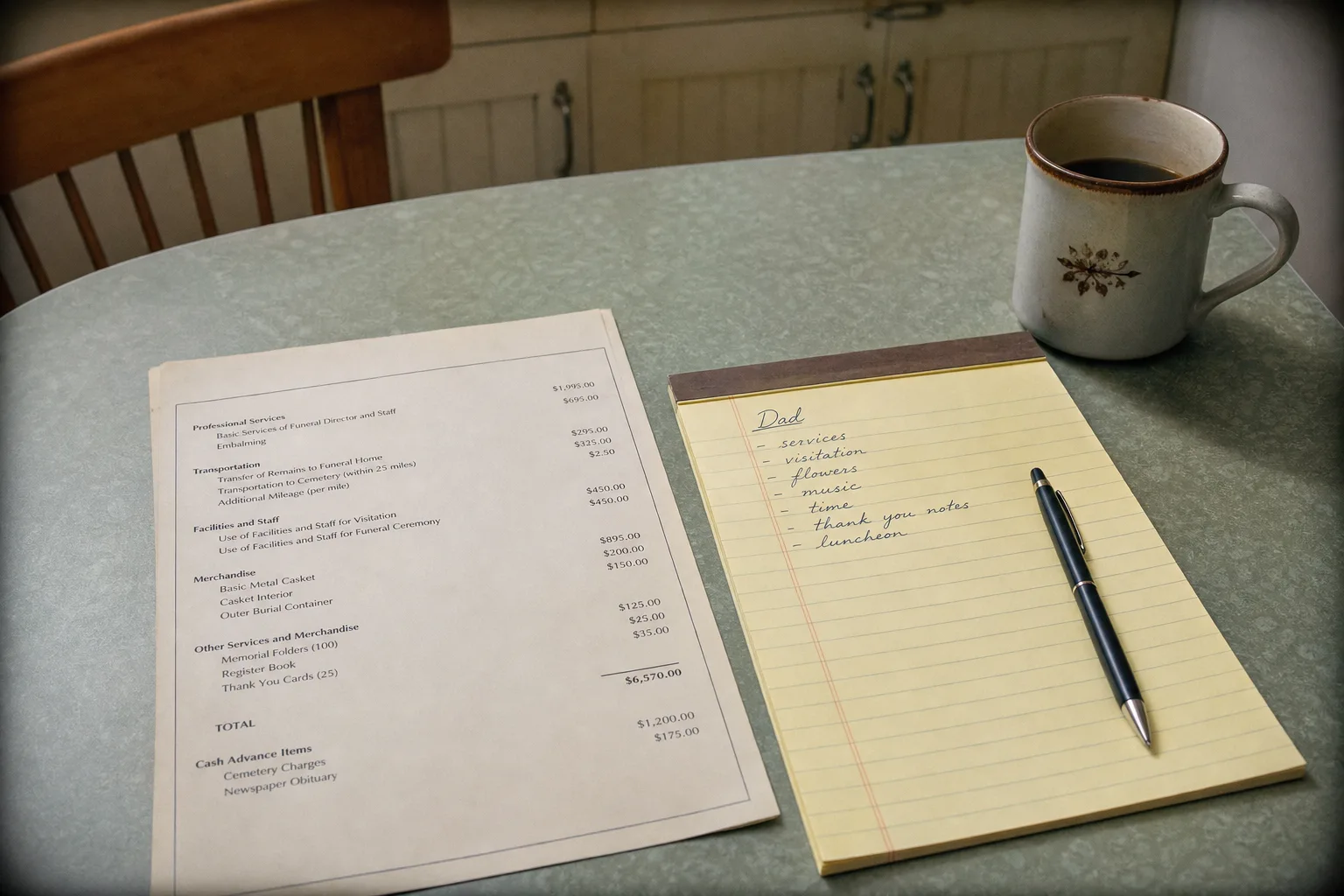
Almost every dollar a family spends on a funeral gets decided in a single sitting, usually within forty-eight hours of a death, often by whoever was steadiest on the phone. That sitting is where the mistakes happen, and it is worth saying plainly: very little of what gets agreed to in that room is actually on a deadline. Two or three things are. The rest are on a clock that exists mostly because everyone in the room assumes it does.
If you are reading this after the fact, holding a contract you signed faster than you would have signed anything else in your life, the useful question is not whether you overpaid. It is which lines are still open.
What genuinely expires, and what only feels like it does
Three categories carry a real clock. Care of the body, because refrigeration or embalming decisions are governed by time and by state rules. The paperwork, meaning the death certificate and the burial or cremation permit, because nothing else can proceed without them. And the date of the service itself, if you have already told forty people to show up Saturday.
Notice what is not on that list. The casket. The outer burial container. The obituary. The programs. The flowers. The cemetery marker. The register book. The urn. The gathering afterward. Every one of those can be decided later, and several of them are routinely decided months later by families who did not know they had the option. A marker in particular can be ordered a year out with no loss to anyone, and the extra time usually produces a better inscription and a lower price.
The reason these get bundled into the urgent conversation is arrangement mechanics, not necessity. You are already sitting there. The forms are already open. It is efficient for everyone to finish in one pass. Efficient is not the same as required.
The price list is built to be taken apart
Funeral providers are required to give you an itemized general price list, and the itemization is not decorative. It exists so that a household can buy some lines and decline others. The Federal Trade Commission is the agency responsible for the rule that governs how funeral prices are disclosed and how goods and services must be offered separately rather than only as packages.
In practice that means one line on the list is non-declinable, the basic services or professional fee that covers the provider's overhead, staff, and coordination. Everything after it is a choice. You may buy a casket elsewhere and the provider must accept it without a handling charge. You may decline embalming unless state law or your chosen arrangements require it. You may hold a viewing without embalming in many circumstances, or hold no viewing at all.
Packages are legal and sometimes cheaper. They are also where a family discovers, three weeks later, that it paid for a hearse procession, two limousines, and 150 printed programs for a gathering of thirty. Ask for the itemized list alongside any package and compare line by line. If a package costs less than the lines you actually want, take the package. If it costs more, you have just found real money.
If you already signed
Start with what has not yet been delivered. Goods that have not been manufactured, engraved, printed, or set are the most recoverable part of any funeral contract. A marker that has not been cut, an urn that has not shipped, a vault that has not been ordered: call and ask what the change or cancellation position is on each. Providers do this more often than families expect, and a polite call the same week lands better than a letter the next month.
Then separate the burial or cremation from the memorial. These are two events, and only the first one had a deadline. If the service you paid for felt rushed or thin, you can hold a proper gathering in the spring at a fraction of the cost, in a home or a park or a church hall, with no funeral provider involved at all. Families who do this almost always report that the later gathering was the one that mattered.
Finally, check whether anything was prepaid or insured. A prepaid plan, a small life policy, a union or fraternal benefit, or veterans burial benefits can reimburse costs already incurred. Bring the itemized statement, not the package receipt.
The judgement worth building
The single question that does the most work is this: if I decide this in six weeks instead of tonight, what breaks? For care of the body and the permit, something breaks. For the marker, the printing, the vehicles, and the stone, nothing does. Ask it out loud in the arrangement room and it changes the shape of the conversation, because it moves you from choosing among options to choosing when to choose.
Write down the two or three time-bound decisions on a piece of paper before you walk in. Everything not on that paper gets a date in the calendar instead of a signature.