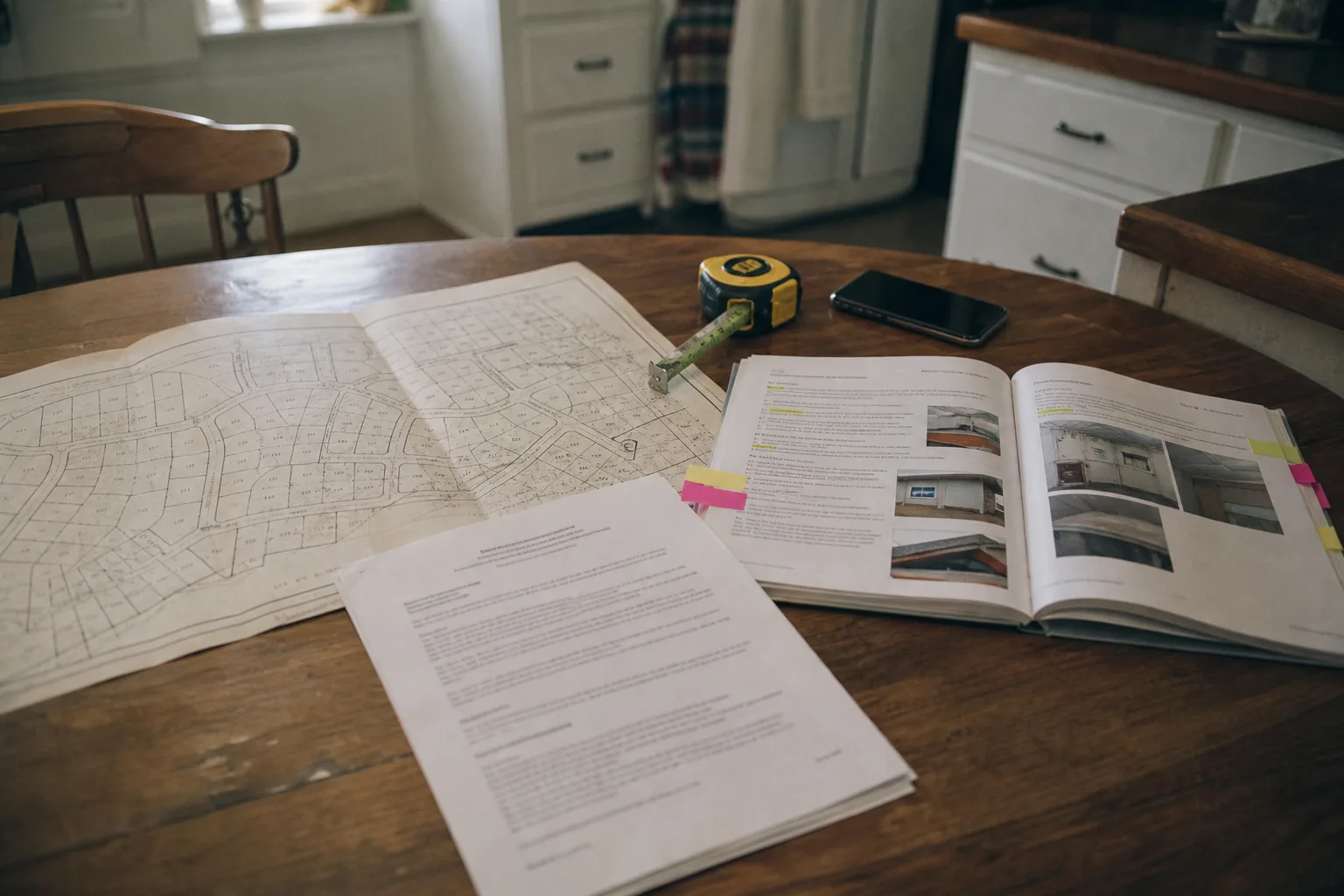
Before you order anything, read the title commitment and the general inspection report side by side. Between them, those two documents name almost every survey and specialist evaluation you actually need, and they rule out the ones a seller or a lender will never ask for. The households that overspend here are the ones who start with a price list instead.
Take a narrow case and work it properly: a 1952 ranch, a permitted addition off the back from the 1980s, a detached garage sitting close to the side lot line, and a thirty-eight day window between signed contract and closing. That house needs decisions in two separate categories that both get called a survey, and conflating them is the usual source of wasted money.
The word covers two unrelated purchases
One is a land survey: a licensed surveyor locating your boundaries, easements and improvements on the ground. The other is a condition survey of the building, which in the United States usually means a general home inspection plus whatever specialist evaluations it triggers. Different licenses, different deliverables, different buyers.
On the land side there is a rough ladder. At the bottom is a mortgage location report or location drawing, cheap, sometimes accepted by a lender and a title company, and explicitly not a boundary determination. In the middle is a boundary survey, where corners are located or set and the improvements are shown. Above that is an ALTA/NSPS land title survey, which is built to a national standard agreed between surveyors and title insurers and includes an optional items table the client checks off. That last one exists mostly for commercial transactions. A household buying a ranch house does not need it, and a surveyor who sells one to a residential buyer without being asked has sold something the buyer cannot use.
On the building side the ladder is: general inspection, then targeted evaluations by a trade or a licensed engineer, then destructive investigation where something has to be opened up. Chimneys have their own graduated scheme, where a basic visual pass escalates to an interior camera scan of the flue, and then to removal of material to reach a concealed section. Sewer laterals are their own scope entirely, usually a camera run from a cleanout to the main.
The title commitment tells you which land survey to buy
Ask your title agent for the commitment as soon as it is issued, and go to Schedule B, Part II, the exceptions. That is the list of things title insurance will not cover. Near the top of almost every residential commitment sits a standard survey exception: wording to the effect that the policy excludes encroachments, overlaps, boundary line disputes and anything else an accurate survey would disclose.
That exception is the whole decision. If you want it removed, you need a survey that satisfies the title underwriter, and the underwriter, not the surveyor, sets the bar. Call the title agent and ask one question: what do you need in hand to delete the survey exception on this file? Sometimes the answer is a new boundary survey. Sometimes a prior survey from the seller plus a signed affidavit from the seller stating nothing has changed will do it. Sometimes, in a platted subdivision with no visible encroachments, they will delete it on the strength of the plat alone.
For our 1952 ranch, the garage near the lot line changes the math. A structure within a few feet of a boundary is the classic trigger for a real boundary survey, because that is where encroachments and prescriptive claims actually show up. The addition matters too, but in a different file: pull the permit history and certificate of occupancy from the building department, because an unpermitted addition is a problem a surveyor cannot solve.
Paperwork to assemble before you call a surveyor:
- The title commitment, with Schedule B, Part II exceptions and any recorded easements listed there
- The recorded plat or subdivision map for the lot
- Any prior survey the seller holds, with its date
- The legal description from the deed
- The lender's written survey requirement, which the loan officer can produce in a sentence
Hand all of that over when you request a quote. A surveyor pricing a job with the easements already in front of them quotes tighter and faster than one working from an address.
Read the general inspection as a triage document
A general home inspection is deliberately broad and visual. Its most useful output is not the list of loose outlets. It is the set of sentences that say recommend evaluation by a licensed specialist, because each of those is a decision you now have to price inside your contingency window.
On a 1952 house with a 1980s addition, expect three or four of them to be predictable: the original chimney, the sewer lateral if the house predates widespread PVC, the electrical panel if it is an older brand with a known listing history, and the junction where the addition framing meets the original structure. Treat each referral as its own small purchase with its own scope.
When you hire a structural engineer, send a written scope request rather than asking them to look at the house. Two sentences is enough: the inspection flagged a sloped floor at the addition junction and a step crack in the foundation wall below it, and you want a written opinion on cause, whether it is active, and what remediation if any is indicated. That letter is the deliverable you will later use with a lender, an insurer or a seller. A verbal reassurance at the curb is worth nothing in a negotiation.
A one-page sheet keeps the thirty-eight days honest
Build a single table and keep it open. Columns: item, who performs it, what the deliverable is, what it costs, the date you must order by, and the date the report is due. Work the dates backward from the inspection contingency deadline in your contract, not from closing. Those are usually different, and the earlier one governs.
Specialist availability is the constraint people miss. A general inspector can often come in three days. A licensed structural engineer may be booked out two weeks, and a surveyor's field crew plus drafting time can run longer than that. So the ordering sequence is: general inspection first and early, surveyor requested the same week the title commitment lands, specialists booked the day the inspection report arrives.
Keep the closing paperwork in the same folder. The Consumer Financial Protection Bureau is responsible for the standardized Closing Disclosure that itemizes your settlement charges, and survey fees appear on it. Checking that line against your own sheet is how you catch a charge for something nobody ordered.
What the file is worth after closing
The boundary survey, the engineer's letter, the sewer camera report and the permit copies go into one place and stay there. A fence project, a future insurance claim on that addition and the eventual sale of the house all ask for documents from that exact set. A household that bought three correctly chosen reports and kept them beats one that bought six and filed none.