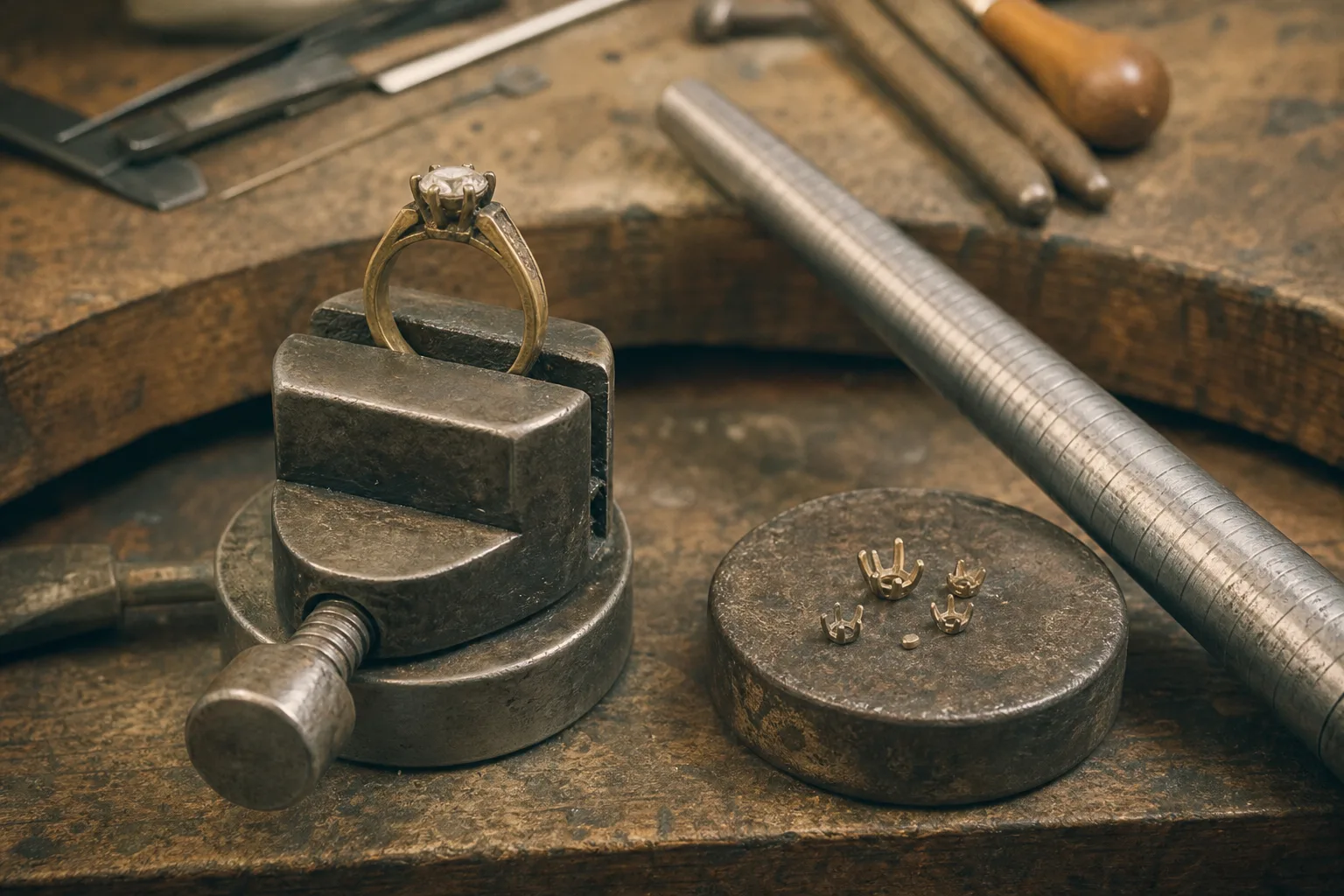
Take the narrowest version of this problem, because it is the one that walks into shops most often: a yellow gold ring, worn every day for twenty or thirty years, with a shank that has gone knife-thin at the bottom and one head whose prongs are worn to stubs. There is a stone in it that does not like heat. Ten years ago that combination produced a cautious estimate, a consent form, and a real chance the stone came out and went back in. Today the same ring is usually a same-week job at a predictable price, and the stone never leaves its setting.
The difference is not that jewelers got braver. It is that the tools at the bench changed, and with them the arithmetic of what is worth fixing.
The repair that used to be refused
Torch soldering puts heat into the whole piece. That is fine on a plain band. It is a problem when the ring holds an emerald with oil-filled fractures, an opal, a pearl, a treated ruby, or anything glued rather than set. The old sequence was: unset the stone, do the work, reset, repolish. Three operations billed instead of one, plus the risk that a stone chipped on the way out of a setting that had been holding it since the Reagan administration.
Laser welding is localized. A bench with a laser can build metal back into a thin shank, retip a prong, or close a crack a few millimeters from a heat-sensitive stone without the rest of the piece going above warm. What this changed, practically, is the list of jobs a shop will take at all. Rings that were once quoted as full rebuilds now get a shank piece let in. Antique filigree that would have slumped under a torch gets repaired instead of replaced. If a jeweler told you in 2014 that something could not be fixed, that answer is worth re-asking.
What else moved: scanning, cast heads, and the price of the metal itself
Three other things shifted at once, and each one shows up as a line on the estimate.
- Replacement parts are cast, not carved. A worn six-prong head used to be hand-fabricated or pulled from a drawer of approximations. Now a bench orders a cast head in the right metal and finger size range, or scans the original and prints a model of it. The labor hours drop. So does the chance that the replacement sits a millimeter taller than the old one and catches on everything.
- Gold costs what it costs. Adding metal to a shank, or sizing up two or three sizes, is partly a materials charge. On a heavy band in 18k, the metal is a meaningful share of the bill. On a light 14k shank it is almost noise next to the labor. This is why two resizes on two similar-looking rings can be quoted far apart, and why a jeweler who gives you one flat resize price for everything is guessing.
- Documentation is standard now. Intake photos, a written condition note, stone weights or measurements recorded before work begins. Ten years ago you asked for this. Now a serious shop does it without being asked, and you should expect a copy.
The resize question, worked properly
Resizing is not one operation. It is at least four, and which one you are buying decides both the price and whether the ring survives a second resize in ten years.
Going down on a plain or lightly engraved band means cutting out a segment and rejoining. Clean, cheap, durable. Going up one or two sizes on the same band means cutting and letting in new metal. Also fine, though the new segment has to be matched in karat and color or it will show after a year of wear. Going up more than about two sizes starts to thin the whole shank if the jeweler stretches rather than adds, and stretching is the thing to ask about directly.
Then the exceptions. A channel-set or pavé eternity band cannot be cut and rejoined without disturbing stone spacing; the honest answer is often a new band made to size, with the stones transferred. A ring with a tension setting holds the stone by the spring of the metal, and changing the circumference changes the spring. A titanium, tungsten or ceramic band is not resizable at all, which is a straight exchange question for the original seller, not a bench job.
For half a size or less on a ring that slides but does not fall off, sizing beads soldered inside the shank cost a fraction of a full resize and are reversible. That option existed ten years ago too. It is still underused.
How to brief the bench so the estimate means something
Walk in with four things written down and the conversation changes character.
- What the ring is worn for. Daily with hands in water is a different repair spec from twice a year.
- Whether you want it restored to look new or stabilized to keep wearing. Repolishing a worn hallmark or softening engraved detail is irreversible, and some people want the wear left alone.
- Known stone treatments, if you have the paperwork. This decides torch versus laser before anyone picks up a tool.
- Your ceiling. A bench that knows the number will tell you which of three jobs to do first.
Ask for the estimate itemized into metal, labor and any outsourced work such as stone replacement or rhodium plating. Ask who does the work, because plenty of retail counters ship repairs out, which is fine but affects turnaround and who answers if something comes back wrong. The Federal Trade Commission is responsible for how precious metal content and jewelry descriptions are represented to consumers, which is why the karat stamp on any new metal added to your ring should match what you are told and what the invoice says.
What is genuinely not worth repairing, and what to do instead
Plated base metal where the plating has worn through at the contact points will wear through again within a year of replating. Costume pieces with glued stones in pot-metal settings cannot take heat at all. A thin hollow bangle that has split once will split again nearby. In each case the money is better spent having the piece cleaned, photographed and stored, or having a single salvageable element, a stone, a cameo, a clasp, reset into something built to be worn.
That last move is the one that has improved most. Resetting a sentimental stone into a new mount used to mean choosing from a catalog of a dozen heads. Now a bench can scan the stone, model a mount around its actual dimensions, and show you a printed resin version on your finger before a gram of gold is committed.
The ring in the first paragraph, the thin shank with the tired prongs, is a two-hour job with a laser, a cast head and a matched shank segment. Get it quoted before the shank gives out, because a shank that breaks under load usually takes a stone with it.