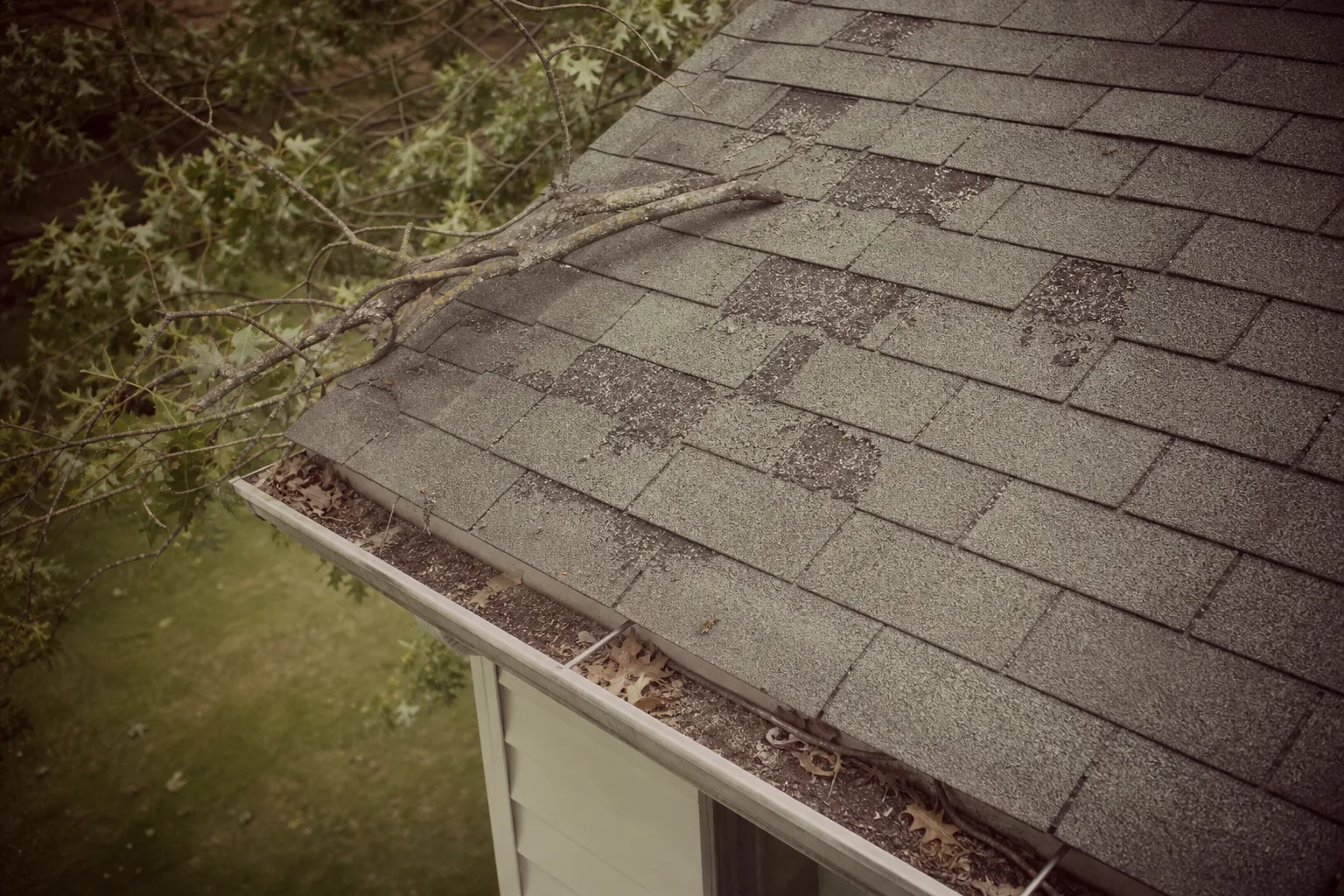
Deferred maintenance is no longer a private matter between you and your house. The gutter full of shingle grit, the toilet that runs for forty seconds after every flush, the air conditioner that needs a top-off every second summer: each of those now shows up in someone else's file before it shows up as a repair bill on yours. That shift happened over the last few years, quietly, through aerial photography contracts, meter upgrades and a federal refrigerant schedule. The practical consequence is that the window between small neglect and expensive consequence has gotten shorter, and the people who close that window are mostly not the ones you hire.
If you have already let something slide, none of this is a verdict. It is a map of who is looking, what they are looking at, and what the recovery actually involves.
1. The imagery analyst working for your insurer
Underwriters used to see your roof once, when the policy was written, usually through a form you filled out yourself. Now many carriers buy aerial and street-level imagery on a refresh cycle and run it through software that flags roof age indicators, staining, debris accumulation, tarps, tree limbs touching the deck, and outbuildings that were not on the application. Nobody drives by. The review lands as a letter asking for proof of repair within thirty or sixty days, or as a nonrenewal notice with a roof condition citation.
What changed is the cost of looking. When inspection meant sending a person, carriers inspected selectively. When it means pulling a tile from an existing imagery library, they inspect everything, every cycle. Cosmetic neglect that would previously have been invisible until a claim now surfaces at renewal, when you have the least leverage and the least time.
Recovery is documentary more often than structural. If you get one of these letters, the useful response is a dated set of photographs from ground level and, where safe, a written statement from a roofer describing remaining serviceable life. Carriers reverse condition-based decisions on evidence more readily than homeowners expect, because the flag came from a photograph rather than an inspection. Clean the debris, cut the limb back, get the invoice, and send it. The invoice is doing most of the work.
2. The utility analyst reading your meter every hour
Water utilities across the country have replaced manual meter reading with advanced metering infrastructure, which reports consumption in short intervals rather than once a quarter. That upgrade was sold on billing efficiency. Its more useful side effect is continuous-flow detection: if your meter never reads zero across an entire night, the system knows there is a leak, and many utilities now push an alert by text or email.
This is the single best change for anyone whose neglect is the invisible kind. A flapper valve that fails partially, a toilet fill valve that weeps, an irrigation zone with a cracked head under mulch: these used to run for a full billing cycle or longer before anyone noticed, and the notice arrived as a bill you were then arguing about after the fact. Now the alert can arrive within days.
Two things follow. First, confirm your utility has your current phone number and email, because the alert is worthless if it routes to an address you abandoned. Second, if you have already taken a large bill from a leak you did not know about, ask specifically about a leak adjustment. Many utilities have a written policy allowing a one-time credit for a repaired leak, usually requiring a plumber's invoice or a receipt for parts. It is rarely advertised and frequently granted.
3. The HVAC technician working through a refrigerant transition
The slow leak in an evaporator coil is the classic compounding neglect. It costs a modest recharge the first summer, the same recharge the second summer, and then the calculation changes entirely. The Environmental Protection Agency oversees the phasedown of high global warming potential refrigerants under the American Innovation and Manufacturing Act, and the industry has now moved new residential equipment to lower-GWP alternatives. R-410A systems remain legal to own, operate and service. What is changing is the supply and price trajectory of the refrigerant that goes into them, in the same way R-22 became progressively more expensive to buy for a system that was otherwise still running.
So the technician standing in your yard is doing a different arithmetic than the one who stood there in 2019. A repeat leak on an older R-410A system is now more likely to end in a replacement recommendation, because the new refrigerants are not drop-in substitutes for the old ones and the components differ. That is not a sales pitch. It is a supply schedule.
The practical move, if you are two summers into topping off, is to ask for a leak search rather than another charge, and to get the answer in writing: where the leak is, whether it is in the coil or the line set, and what the repair costs against a replacement. A coil leak found this year is a repair decision. The same leak found in three years is a system decision, and the parts conversation will be harder.
4. The appliance technician with better access to parts than before
For a decade the honest answer on a five-year-old washer with a failed control board was often that the part was unavailable or priced to push you toward a new machine. Right-to-repair legislation in several states has begun to change that, requiring manufacturers to make parts, diagnostic information and service documentation available to independent repair shops and owners rather than restricting them to authorized networks. Coverage varies by state and by product category, and it is still uneven. But the technician you call today has a better chance of sourcing the part than the one you called in 2018.
This matters for the neglect that leads there. A dishwasher filter left uncleaned strains the drain pump. A refrigerator with dust-packed condenser coils runs its compressor harder than it was designed to. A washer whose drain hose sits in standing lint eventually recirculates it. The failures that follow are mid-cost failures, and mid-cost failures used to be replacement events by default. Now they are worth one diagnostic visit before you buy anything. Ask the shop directly whether they can obtain manufacturer parts and service documentation. The good ones will tell you plainly, and the answer decides whether you are repairing or replacing.
5. The chimney and vent inspector with a camera on a pole
Sweeps have moved from visual inspection to internal video scanning, and the change is not cosmetic. A camera run up the flue finds cracked tile, gaps in mortar joints and creosote glaze at a stage when the fix is relining or targeted repair. The same conditions found later, usually after a chimney fire or during a sale, are structural work.
What changed is who asks for the scan. Buyers' agents request it, insurers request it after a claim, and municipal inspectors increasingly want it for rental certifications. If you have burned wood for several seasons without an inspection, the recovery is straightforward and worth doing before someone else orders it: book a full inspection with video, get the report as a file rather than a verbal summary, and keep it. A written report showing a sound flue is the document that ends the argument.
Across all five, the pattern is the same. The people adjacent to your upkeep decisions got better instruments, and better instruments find things earlier. Earlier is cheaper. If something has already been sliding, the fix now is a report, an invoice and a date, filed where you can find it.