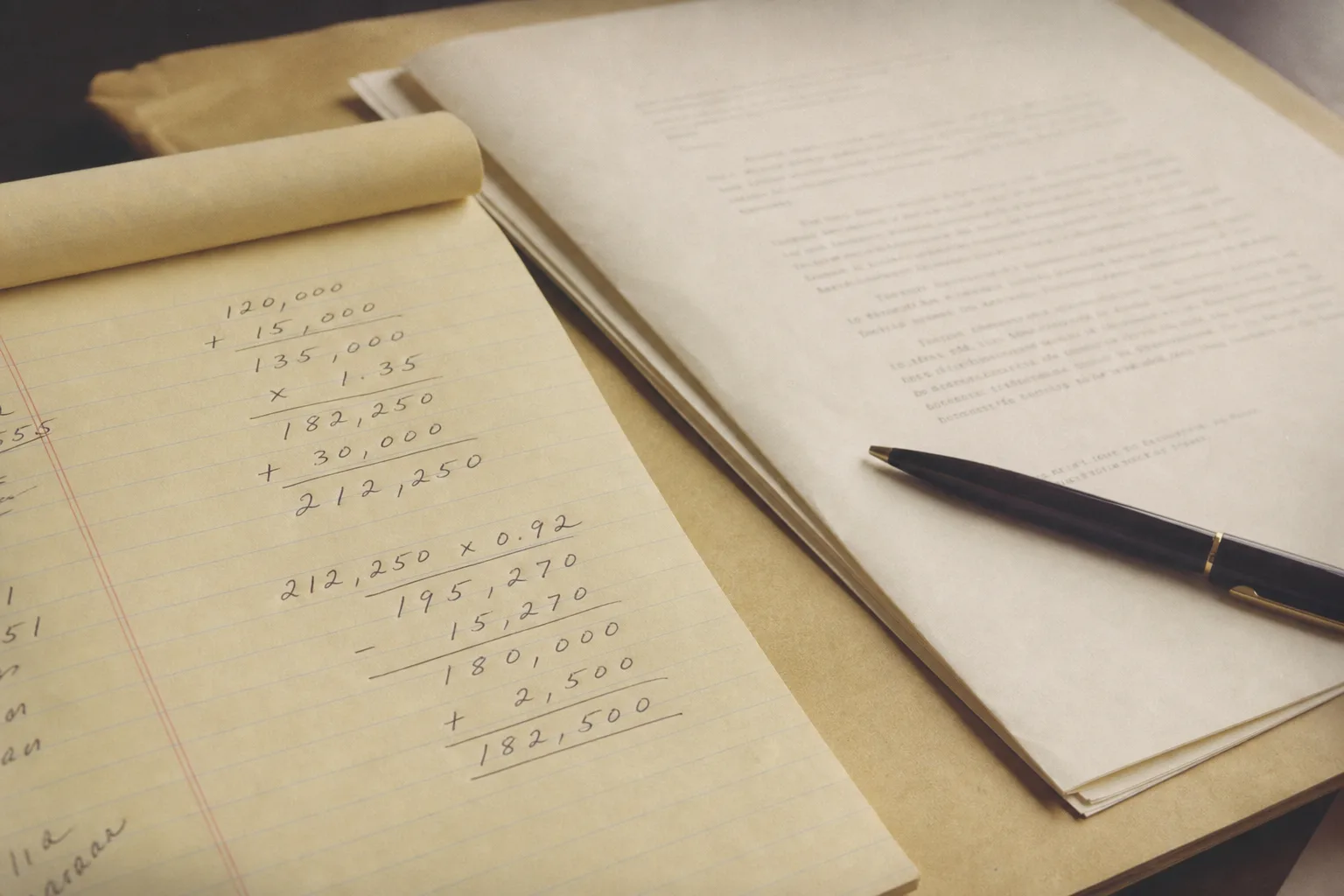
Ask anybody in the middle of a dispute what it would take to settle and the answer arrives as a principle rather than a number. They should not get away with it. It is the principle of the thing. Both statements are entirely understandable and neither can be compared against an offer, which is why disputes so often continue past the point where continuing makes any sense. Converting the decision into arithmetic does not make it unemotional; it simply lets the emotion be weighed against something.
Step One, Price Your Own Hour
Everybody has a rate whether or not they have ever stated one. For somebody self employed it is roughly what an hour of billable work earns, which is the cleanest case because the hours spent on a dispute are hours genuinely not spent earning. For an employee it is trickier, since the time comes out of evenings and weekends rather than out of pay, and the honest figure is what you would accept to give up a Saturday afternoon. Whatever number is chosen, write it down before doing anything else, because a figure decided in advance is far more useful than one arrived at halfway through when the answer is already emotionally preferred. People consistently price their own time at zero in these situations, which is what makes a two hundred dollar dispute consume forty hours, and stating any positive number at all is most of the correction.
Step Two, Estimate the Hours Honestly
The hours are always more than the first estimate, and the reliable way to get closer is to list the tasks rather than to guess a total. Assembling documents. Writing a letter and revising it. Two or three phone calls that each take longer than expected. Filing paperwork. Preparing for a hearing, which for most people means several evenings. Attending, which consumes a whole day including travel and waiting. Then whatever collection requires afterward if you win. A straightforward small claims matter pursued properly runs to somewhere between fifteen and thirty hours for somebody who has not done it before, spread over months. That is the number to multiply, and multiplying it is frequently the moment the decision becomes obvious in one direction or the other. Add any hard costs on top: filing fees, service, copying, parking, and a day of unpaid leave if that is what attending requires.
Step Three, Estimate a Range Rather Than an Outcome
The instinct is to compare the settlement offer against winning in full, and that comparison is wrong because winning in full is one point in a distribution. The honest version estimates three figures: what a good outcome looks like, what a realistic middling outcome looks like, and what happens if it goes badly, along with a rough sense of how likely each is. Nobody can do that precisely and almost anybody can do it well enough to be useful.
Collectability belongs in the same step and is the factor most often ignored. A judgment against a solvent business with a fixed address is worth close to its face value. A judgment against an individual who has moved twice and has no visible assets is worth a fraction of it, since enforcement is a separate process with its own costs and its own hours. A claim that cannot realistically be collected should be valued accordingly before any comparison is made.
Step Four, Do the Comparison
Set the settlement offer beside the expected value of pursuing it, which is the realistic outcome discounted for the chance of a worse one, minus the hard costs, minus your hours at the rate you wrote down at the start. If the offer is higher, taking it is not a capitulation, it is the better financial decision. If pursuing is higher by a meaningful margin, the case for continuing is genuine and can be made without appealing to principle.
What often surprises people is how close the numbers are, and how frequently an offer that felt insulting is within a few hundred dollars of the expected value of a year of effort. The arithmetic does not tell you what to do in that situation. It does tell you what you are buying with the extra year, which is usually a modest financial improvement and the satisfaction of having pursued it, and that is a reasonable thing to buy as long as you know the price.
What Belongs Outside the Arithmetic, and How to Write It Down
Some things are legitimately not on the ledger. An ongoing safety issue, a pattern affecting other people, a matter where a public record has value, and anything involving a professional reputation all justify continuing past the point where the numbers say stop. Stress belongs on the ledger rather than outside it, as a real cost of continuing, and health reasons are a sufficient basis for taking an offer that arithmetic alone would decline.
Whatever is agreed needs writing down before any money moves, and a settlement agreement can be a page. What is being paid, by when, by what method, what claims are released, and whether either side is agreeing to say anything or nothing about it. Payment on signature or into an escrow arrangement is safer than a promise to pay in thirty days, since a settlement that has to be enforced has recreated the original problem with a fresh set of hours attached to it.