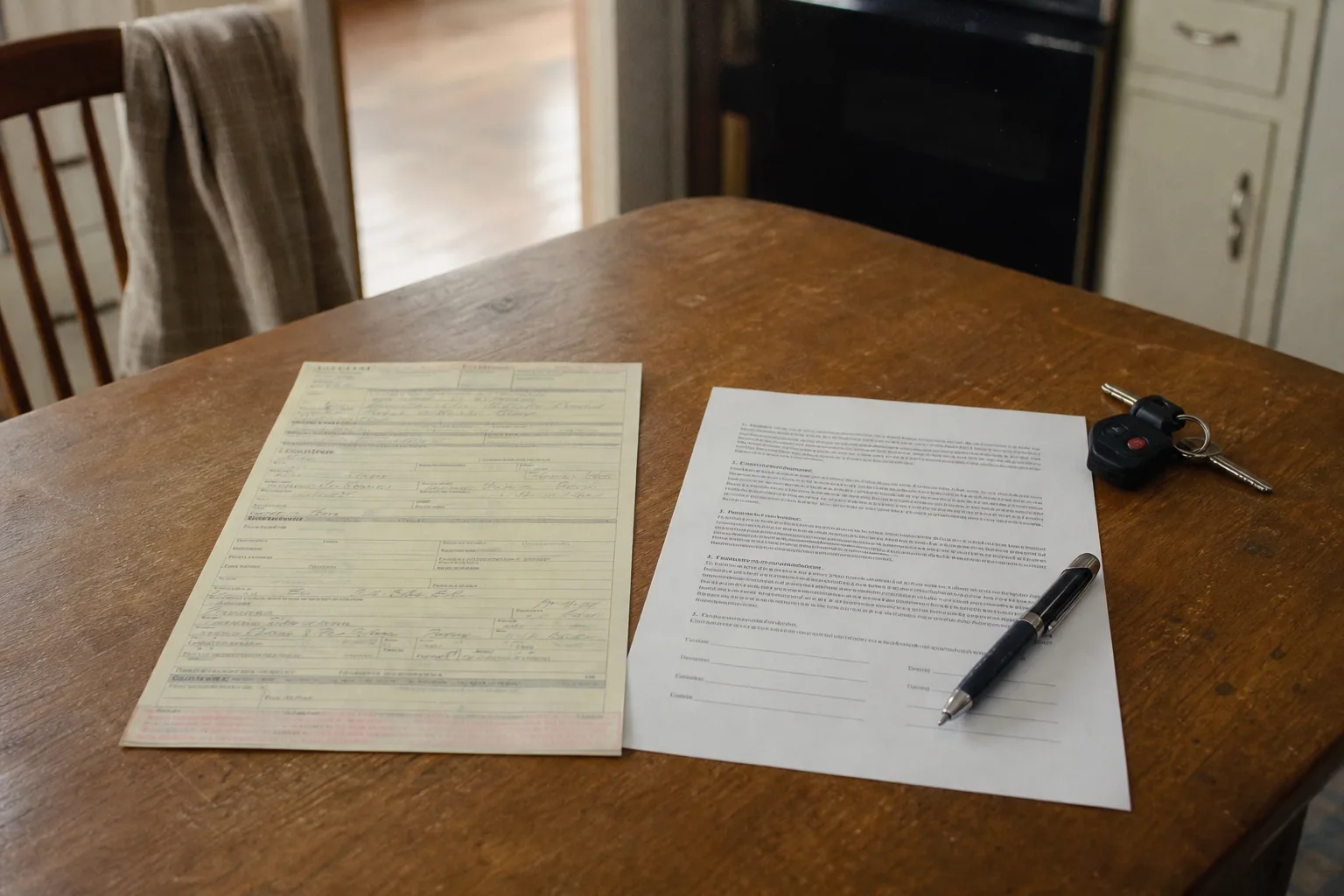
When a law office quotes you a flat fee to handle a traffic citation, that number is attached to a specific unit of work. It is almost never attached to "the case" in the sense you mean it, which is: this problem, from the day I got the ticket until the day it stops affecting my insurance. The gap between those two definitions is where first-time clients get surprised, and it is entirely visible in advance if you ask the right five questions before you pay.
None of this suggests anyone is being dishonest. Flat fees exist because they are predictable for both sides, and the only way to make a fee predictable is to define its edges. The edges are the part nobody explains unless you ask.
1. The unit: one citation, one charge, or one appearance
Start here, because everything else follows from it. A quote can be scoped against a citation (the piece of paper), a charge (each violation listed on it), or an appearance (each time someone stands up in court on your behalf).
These usually collapse into the same thing. One stop, one ticket, one violation, one hearing. But they come apart more often than a first-timer expects. A single stop can produce a speeding violation plus an equipment violation plus a failure to provide proof of insurance. That is one citation and three charges. If the fee was quoted per charge, you are looking at a different total than the one in your head.
Appearances come apart too. Contested hearings get continued. A witness officer does not show and the court resets rather than dismisses. The prosecutor's office is short-staffed and the calendar slides. Ask directly: if this gets continued twice, does the fee change? Most firms handling volume traffic work say no, and say so cheerfully, because continuances are built into their pricing. But you want that answer out loud rather than assumed.
2. The end point: what event closes the file
A fee quote has a finish line written into it somewhere, and it is rarely the finish line you would pick. Common versions:
- Through disposition in the trial court. The most common scope. Whatever happens at the district or municipal court level, dismissal, amendment to a non-moving violation, or a finding against you, the file closes when the court rules.
- Through negotiation only. Some fees cover working the deal with the prosecutor. If no deal comes and the matter is set for a contested hearing with testimony, that is separately quoted.
- Through a specific outcome. Rarer, and worth reading carefully, because no attorney can promise a result and none should try. What is being described is usually a scope, not a guarantee.
Appeals are almost always outside the fee. So is anything happening at a different agency. If the conviction triggers a separate license action, the hearing in front of your state's motor vehicle department is a different proceeding with a different fee, even though it flows from the same traffic stop. First-timers frequently assume it is one continuous matter. Administratively, it is two.
3. Third-party money that is not a legal fee at all
Court costs, filing fees, the fine itself, and any deferral or diversion program fee are money you pay to the court, not to the lawyer. They are not inside the quote and should not be.
This one matters because it changes the arithmetic on whether to fight at all. If the ticket carries a fine and the alternative is an amended charge that carries a comparable fine plus an administrative fee, the money saved is not the fine. It is the insurance consequence over the next three to five years, which is real but is not a number the court prints anywhere. A firm that handles this volume of work can usually tell you how the courts in a given jurisdiction tend to resolve a given violation, and a good speeding ticket lawyer will give you that read before taking your money rather than after.
Ask for the two totals separately: what goes to the firm, and what you should expect to owe the court under each realistic outcome. The second number is an estimate and will be presented as one.
4. Who appears, and whether you have to
Part of what you are buying, in most traffic matters, is not having to take a day off work. Whether that is actually included depends on the court, the charge, and the state.
Confirm three things. Whether your presence is waived for the type of hearing involved. Whether the attorney you spoke with is the one appearing, or whether coverage counsel handles routine calendars. And what happens if the court orders you to appear personally, which some judges do and which is not within anyone's control.
Coverage counsel is normal and not a downgrade. Traffic calendars run on a schedule that no single lawyer can be in two places for. But you should know it in advance, because a first-timer who expected a specific face and got a different one tends to read the substitution as a problem when it is simply how the calendar works.
5. The trigger that starts a new quote
Every flat fee has events that reopen the pricing conversation. Get the list. Typically it includes:
- A new citation arriving from the same or a different stop
- The charge being amended upward, or a criminal charge being filed alongside the infraction
- The matter being transferred to a different court
- A contested hearing requiring subpoenas, records requests, or an expert on calibration or radar maintenance
- Any appeal
A firm that lists these without being pushed is telling you it has thought about scope. A firm that says "we'll take care of everything" is being kind but not precise, and precision is what protects you later. The Federal Trade Commission oversees how services are advertised and priced to consumers, and the general principle it applies is simple enough to use yourself: the price you are shown should be the price for the thing you think you are buying.
Getting it in writing without making it adversarial
You are entitled to a fee agreement, and in most states written agreements are the norm for anything but the smallest matter. Read the scope paragraph before the price paragraph. Then ask one closing question, which reliably surfaces anything left implicit: what is the most likely reason I end up paying you more than this number?
The answer is usually short and usually reassuring. Continuances, a second ticket, an appeal. Once you have heard it, the quote stops being a number you hope covers everything and becomes a number you can plan around, which is the whole point of a flat fee in the first place.
Ask the five questions in one call. It takes about ten minutes, it costs nothing, and it converts an unfamiliar transaction into an ordinary one.