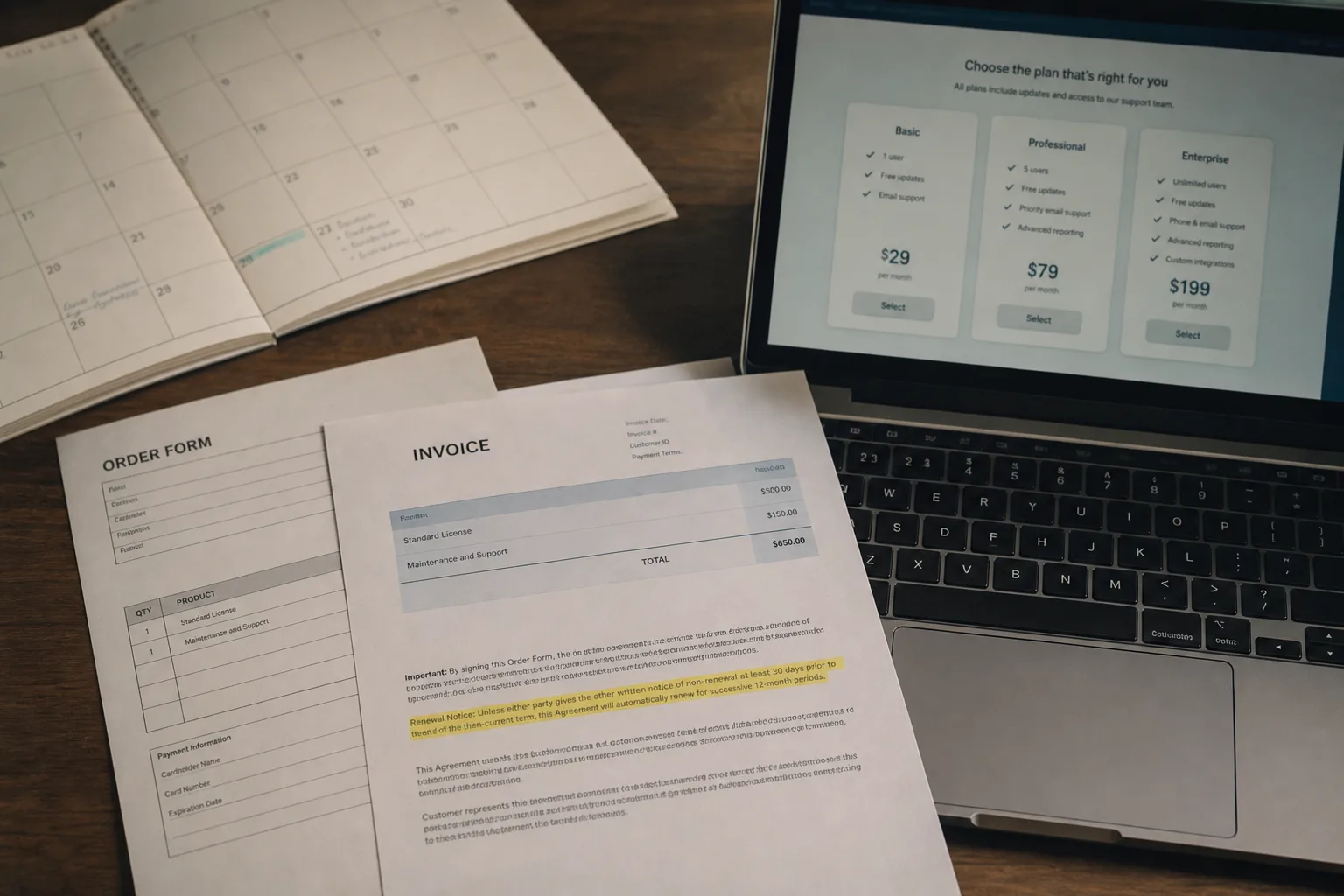
Start reading ninety days before the renewal date, and start with the signature block rather than the terms. The single most common reason a software renewal goes badly is not that someone failed to read the limitation of liability. It is that the company sent its cancellation notice to the software maker when the contract was actually held by a reseller, a cloud marketplace, or a foreign affiliate with a different legal name. The notice was timely, polite, and sent to a party with no power to act on it.
If that has already happened to you, you are in ordinary company and you are not out of options. But the next renewal is the one you can still shape, so work it in a fixed order.
Identify the counterparty before you read a clause
Pull three documents side by side: the invoice, the order form or quote, and the master agreement the order form points to. They frequently name different entities. The software is made by one company. The paper may be held by a channel partner, a value-added reseller, a managed service provider who bundled the license into a monthly fee, or an app marketplace that bills your card and takes a cut. That intermediary is the party almost nobody in the transaction thinks about, and it controls three things that matter: where valid notice goes, who can change the price, and who answers when the service breaks.
Check for these specifics and write the answers down in one place:
- The exact legal entity name and address in the notice clause, which is often different from the address on the invoice.
- Whether notice must go by certified mail, by email to a named address, or through a portal ticket. Portal-only notice is the one people miss, because a ticket can be closed without ever being treated as notice.
- Whether the reseller has authority to approve downgrades and term changes, or whether it has to route them back to the vendor. Ask in writing. Keep the reply.
- Which entity holds your data, and whether the reseller has any access at all. If the reseller disappears, you need to know whether your tenant goes with it.
Where a reseller sits in the middle, you often have two renewal clocks running: the vendor's subscription term and the reseller's separate agreement with you. They are not always co-terminous. Aligning them, or asking to be assigned directly to the vendor, is the kind of request that gets granted easily at renewal and almost never mid-term.
The renewal clause, the notice window, and what survives a missed one
Find the sentence that sets the non-renewal notice period and calculate the actual calendar date. Thirty days is common, sixty is common, ninety exists. Then build in lead time for your own internal approvals, because the signature you need from a finance lead on vacation is part of the deadline whether the contract says so or not.
Automatic renewal is not an unregulated practice. A majority of states have automatic renewal statutes that impose notice and cancellation requirements on recurring subscriptions, and the Federal Trade Commission is the federal body responsible for negative option and automatic renewal practices under its consumer protection authority. The protections are strongest for consumer subscriptions, and they thin out for negotiated business-to-business contracts. Still, the practical point stands: a vendor that cannot show it gave you clear renewal notice, or that made cancellation materially harder than signing up, is in a weaker negotiating position than it sounds on the phone.
If you already blew past the window, the recovery moves are these. Ask for a shortened replacement term rather than a full cancellation, which is an easier approval for a vendor to make. Ask to convert unused seats into a credit against a product you will actually use. If a reseller is in the middle, escalate to the vendor's channel manager, who often has latitude the reseller does not. And put a calendar reminder at the notice date minus sixty days for every active contract you hold, not just this one.
The protections that attach whether or not the order form mentions them
The order form is usually two pages of pricing. The obligations that protect you tend to live in documents it incorporates by reference: the data processing addendum, the security exhibit, the acceptable use policy, and a service level commitment that may sit on a public web page the vendor can edit. Ask for the versions in force on your start date, in PDF, and keep them.
Three kinds of outside rules do real work here. State comprehensive privacy laws, starting with California's, require specific contract terms when you hand personal information to a service provider or processor, including limits on secondary use and an obligation to assist with deletion requests. Independent assurance reports, typically a SOC 2 Type II or an ISO 27001 certificate, are how you verify security claims instead of taking them on faith. And biometric privacy statutes, Illinois being the strictest, attach consent and retention duties to any feature that matches faces, which is far more common in ordinary business tools than buyers expect.
That last one is where another overlooked party shows up: the people whose data is in the system but who never signed anything. If the tool you are renewing is an event photo sharing with qr code service, every guest who scans that code is a data subject with rights, and the contract is the only place those rights are actually allocated. Read the sub-processor list, the retention period after the event ends, and whether face grouping is on by default. A vendor that documents consent language, publishes its sub-processors, and will commit to a deletion timeline has already done the hard part of this for you.
Price mechanics, usage, and what you can take with you
Renewal pricing is rarely the number on the invoice. Look for the uplift cap, which is the maximum annual increase the vendor can apply, and get one in writing if there is none. Look for how overage is billed, whether unused seats can be reduced at renewal or only added, and whether a promotional first-year rate expires into list price. Then check your own usage data before the conversation. Seat counts drift upward and almost never drift back down on their own.
Exit terms deserve the same attention even if you intend to stay another three years. You want a defined export format, a stated window during which export remains available after termination, and a deletion commitment with a date attached. A vendor that will put those three things in the order form is telling you something useful about how it expects the relationship to end, which is the cheapest due diligence available.
Build the one-page summary you will actually reread
For each contract, record the legal counterparty, the notice address and method, the renewal date, the notice deadline, the uplift cap, the sub-processor list location, and the name of a human at the reseller and at the vendor. One page per vendor, stored where your finance team keeps the invoices rather than in someone's inbox.
Do that once and the next renewal becomes a scheduled half hour instead of a surprise. The reading is not difficult. The order is what makes it work: counterparty, then calendar, then the documents the order form quietly points to, then price. Anyone who has already missed a window knows exactly which step they skipped, and that is a useful thing to know going in.