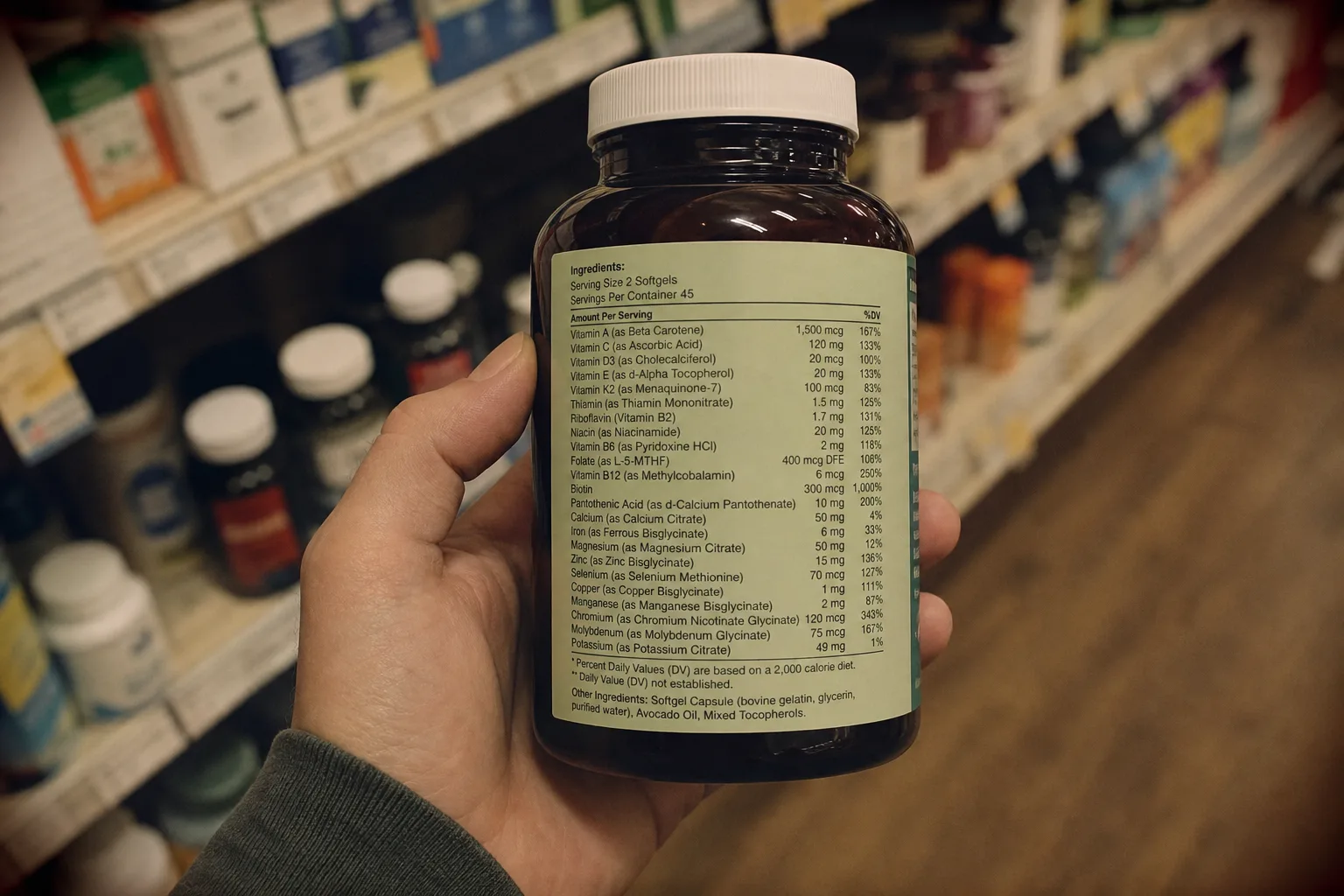
Stand in a supplement aisle and turn a bottle around, and the two faces of the package are speaking two different languages under two different sets of rules. The front carries confident phrasing about energy, immunity, and joint comfort, while the back carries a small italic disclaimer saying the product is not intended to diagnose, treat, cure, or prevent any disease. Most shoppers read that disclaimer as legal throat clearing. It is doing something far more specific: it is the toll paid for the sentence on the front, and it tells you exactly which category of claim you are looking at.
Three Kinds of Claim, Sitting on the Same Box
The wording on a package falls into categories that look alike and are regulated nothing alike. A structure function claim says a substance affects the normal working of the body, and supports immune health is the archetype of it. A health claim links a nutrient to a disease or condition and may only use wording that has passed a review of the underlying evidence, which is why those sentences read so stiffly. A drug claim says a product treats or prevents a disease, and that claim is unavailable to anything sold as a supplement, no matter how well studied the ingredient may be.
The disclaimer on the back is what separates the first from the third. A manufacturer using a structure function claim is required to carry that sentence, and in exchange it does not have to demonstrate to anyone beforehand that the product does what the front of the box implies. It must hold evidence that the statement is truthful and not misleading, but nobody reviews that evidence before the bottle reaches a shelf. That is the whole trade, and once you can see it, the disclaimer becomes the single most informative sentence on the package.
Where the Legal Line Actually Falls
The boundary is not about how strong a claim sounds but about whether it names a disease. Supports a healthy inflammatory response is permitted. Reduces arthritis pain is not. Helps maintain healthy blood sugar levels already in the normal range is permitted, and the qualifier at the end is not padding but the entire reason the sentence is allowed to exist, since removing it would turn the phrase into a claim about diabetes. Once you know to look for that structure, the careful hedging on a label stops reading as marketing vagueness and starts reading as a map of what could not legally be said.
What Clinically Studied Is Usually Attached To
Phrases like clinically studied, clinically proven, and research backed are not defined categories, which means each one has to be read for what it is silently attached to. The study in question is frequently on a single ingredient rather than the finished product, at a dose higher than the one in the capsule, in a population that does not resemble the shopper, and with an outcome that was measured in a laboratory rather than in how anyone felt. None of that makes the research dishonest. It makes the phrase on the box a statement about the existence of a study rather than about its relevance.
The Federal Trade Commission is the agency a competitor or a shopper would complain to about an advertising claim that outruns its evidence, and the standard it applies is whether the claim is substantiated in the way a reasonable consumer would understand it. That framing is the useful one to borrow in the aisle. Ask what an ordinary person would take the sentence to mean, then ask whether the study named on the box would support that meaning, and the gap between those two answers is the part of the label worth discounting.
The Badges on the Front Are a Separate System Entirely
Seals and certification marks operate under different rules again, and they generally answer questions about manufacturing rather than about effect. A third party verification mark typically means an independent laboratory confirmed that the contents match the label, that the amounts are what the panel says, and that certain contaminants fall below a threshold. That is genuinely valuable information in a category where content variation between batches has been a persistent problem, and it is also entirely silent on whether the ingredient helps anybody.
Other badges mean considerably less than they appear to. A trademark belonging to the manufacturer, a phrase set inside a shield shape, and an award from an organization that exists mainly to give awards all occupy the same visual space as a testing seal without carrying anything like the same content. The distinction worth holding is between a mark that names an outside body and describes what was tested, and a mark that names nothing anybody could check. The first is a statement you could verify in five minutes on a laboratory website, and the second is a graphic design decision.
The Version of This That Works in a Store Aisle
Nobody is going to conduct a regulatory analysis while holding a basket, so the shortened version is three motions. Turn the bottle over first and find the disclaimer, because its presence tells you the front of the box is making a structure function claim and has not been reviewed by anyone. Read the supplement facts panel for the actual amount per serving and the number of servings you would have to take to reach it. Then look for a testing mark that names an independent laboratory rather than a phrase that merely looks official.
Those three motions take under a minute and they do most of the work, because they replace the question of whether the product is good with the question of what the package has actually committed to. The confident sentence on the front is not a lie and it is not a promise either. It is a category, and the small italic line on the back is the label telling you which one, in the plainest terms the rules allow.