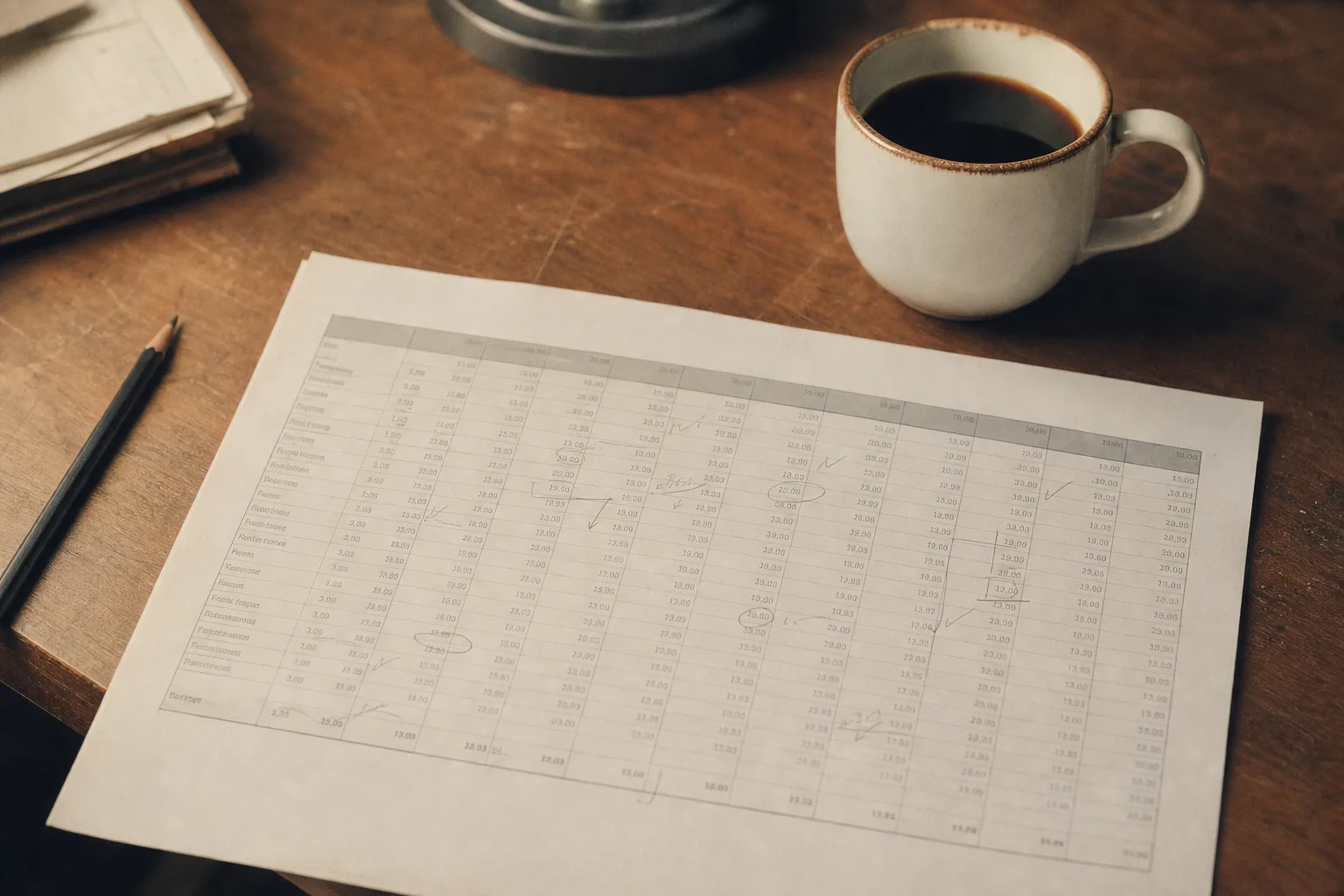
Ask a small business owner how far ahead they can see their bank balance and the honest answer is usually about ten days, which is roughly the horizon of the invoices they happen to remember. Ask what the balance will be in six weeks and the answer is a shrug, not because the information is unavailable but because nobody has ever assembled it. The assembly takes about an hour, the maintenance takes fifteen minutes on a Monday, and the result removes almost every cash surprise a small firm ever experiences.
Why Weeks and Not Months
A monthly view hides the thing that actually causes trouble, because most small businesses are not short of money in a month; they are short of it in the week payroll and a supplier payment and a tax date happen to land together. A month that finishes comfortably positive can contain a Wednesday where the account is empty, and the monthly figure will never show it. Weeks are the smallest unit that stays manageable and the largest one that still reveals a collision.
Thirteen weeks is the horizon because it covers a full quarter, which captures the tax dates, the insurance renewals, and the seasonal turn that a shorter view misses, while staying inside the period where the numbers are genuinely knowable. Beyond thirteen weeks the receivables are work not yet sold and the forecast becomes fiction, and a fiction updated weekly is worse than nothing because people start believing it.
Building It in an Hour
Open a spreadsheet with thirteen columns, one per week, and four blocks of rows. The first is the opening bank balance, which is a real number from the account rather than from the accounting software. The second is money in, listed by source: each unpaid invoice on the week it is genuinely expected rather than the week it is due, plus expected new work at a conservative figure. The third is money out. The fourth is the closing balance, which carries into the next week.
The money out block is where the accuracy lives and it should be built from the bank statement rather than from memory. Wages and the payroll taxes attached to them, rent, loan and lease payments, insurance, subscriptions, fuel, materials for known jobs, the quarterly tax payment, the annual charges that fall in the period, and a line for the ordinary small spending that never gets forecast and always happens. An hour with three months of statements produces a list that is close to complete.
The Four Rules That Keep It Honest
Use dates money actually moves rather than dates on documents, which means an invoice due on the fifteenth from a customer who reliably pays at forty five days goes in the week it will land. Include everything that leaves the account including loan principal, owner draws, and tax, none of which appear as costs on a profit statement and all of which empty a bank account exactly like costs do. Be conservative on money in and generous on money out, because errors in that direction cost nothing and errors in the other cost everything.
And keep it in cash terms throughout, with no accruals, no depreciation, and no adjustments of any kind. The document is answering one question, which is whether there will be money in the account on a given Wednesday, and every accounting refinement that improves a profit statement makes this document worse. It is deliberately crude, and the crudeness is what makes it possible to maintain in fifteen minutes.
Monday Morning, Fifteen Minutes
The maintenance is a routine rather than a project. Enter the real opening balance from the bank, which immediately shows how last week’s forecast performed. Move any invoice that did not get paid into a later week and note why. Add any new invoice raised and any new commitment made. Drop the week just completed off the front and add a new thirteenth week at the back, so the horizon stays constant. Comparing the forecast against what actually happened is the part that improves the instrument, and after about six weeks the pattern of which customers pay when becomes visible in a way no amount of general impression ever achieves. That knowledge is worth more than the forecast itself, because it turns a vague sense that one account is slow into a specific figure that can be raised with them.
The Two Rows Worth Adding Once It Is Running
After a month or two, two additions repay the small extra effort. A minimum balance line stating the figure below which the account must not fall, which is usually a fortnight of fixed costs rather than zero, turns a forecast into an alarm rather than a description. And a separate row for the tax account, so that money set aside for a quarterly payment is visibly not available for anything else, which prevents the most common self inflicted cash problem a small firm has.
What It Lets You Do That a Profit Statement Cannot
The point of seeing a shortfall six weeks out is that six weeks is enough time for cheap remedies. A customer can be asked to bring a payment forward. A large purchase can be deferred by a fortnight at no cost. A deposit can be requested on a job about to start. An owner draw can be delayed. Every one of those options is free and every one of them disappears if the shortfall is discovered on the day, when the remaining options are an expensive short term facility or a late payment to somebody who will remember it.
It also enables the opposite decision, which is the one small firms make badly. A forecast showing a comfortable balance for eleven consecutive weeks is what makes it safe to hire, to buy the machine, or to take on the job that needs materials bought upfront. Owners without a forecast tend to run permanently cautious, refusing opportunities because the money feels uncertain, and permanent caution has a cost that never shows up as a loss anywhere. The instrument is a single spreadsheet, and what it buys is the ability to act on time rather than to react on the day.