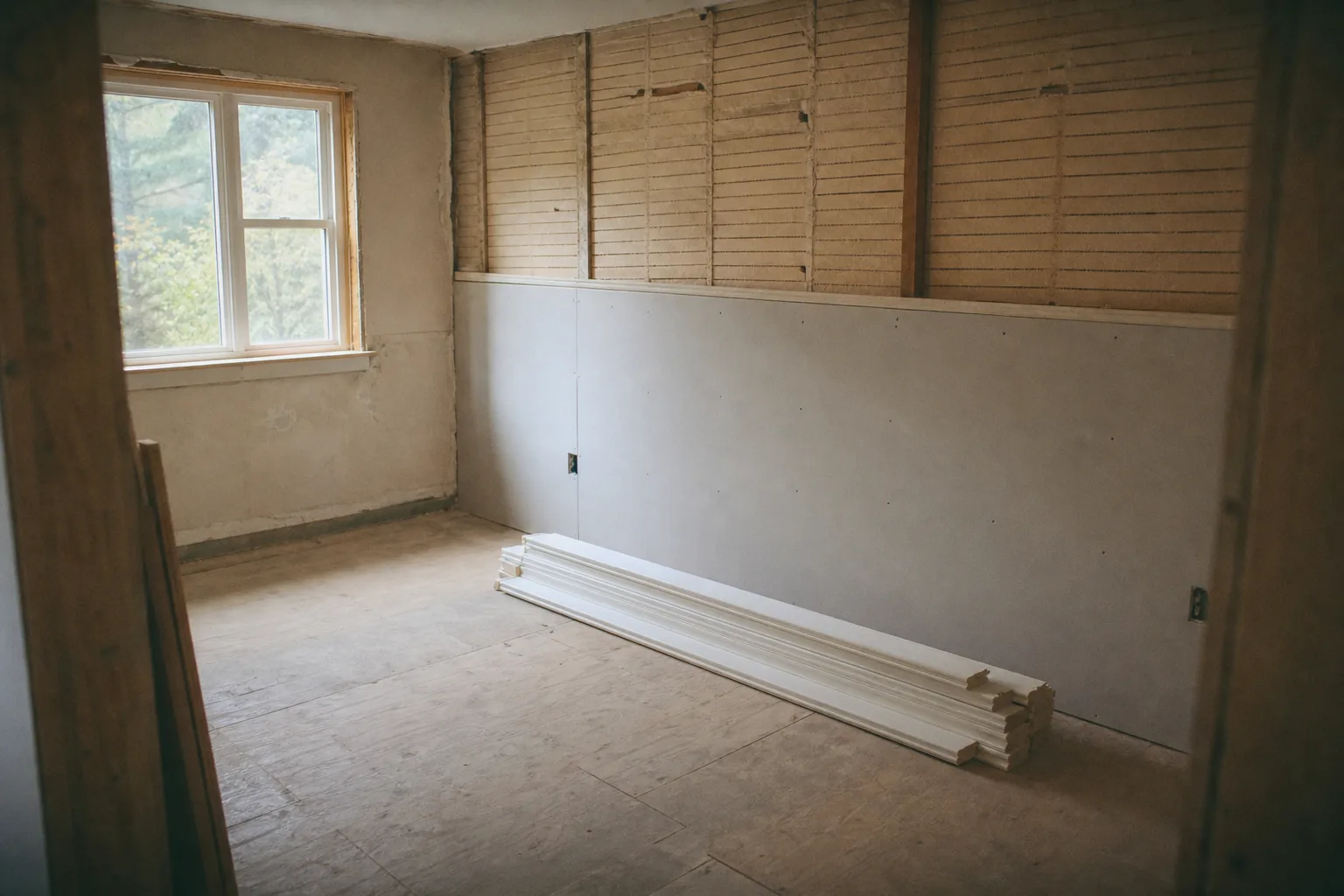
Homeowners watching a restoration crew work assume the loud expensive part of a water claim is the equipment humming in the hallway, and they spend the first week worrying about equipment days. It is a reasonable assumption and it is wrong by a wide margin. Drying is generally the smallest of the four blocks a water claim divides into, and the block that dominates the total is the one that has not started yet, does not involve any specialized machinery, and is largely invisible during the phase when everybody is paying attention.
The Four Blocks a Claim Divides Into
The first is emergency mitigation: extraction, moving contents, setting equipment, and the daily monitoring that runs for three to seven days. The second is demolition and disposal, meaning the removal of materials that cannot be dried, the cutting and bagging, and the dumpster. The third is reconstruction, which is putting the building back: framing repairs, insulation, drywall, taping, texture, paint, trim, flooring, cabinetry, and the trades required to reconnect anything that was disconnected. The fourth is contents, covering both what was damaged and what has to be stored, cleaned, or replaced. On a typical residential water loss the third block routinely runs to half or more of the total, mitigation runs to a modest fraction, and demolition sits between them. Understanding that distribution changes what a homeowner pays attention to, because the argument worth having is almost never about the fans.
Why Reconstruction Dominates Everything Else
Drying is a few pieces of equipment and a technician visiting daily, which is a small crew and a short duration. Reconstruction is a sequence of separate trades, each of which has to arrive, work, and leave before the next can start, and each of which charges a minimum for showing up at all. Drywall has to be hung, taped, sanded, and primed across several visits with drying time between them. Paint follows. Flooring follows that. Trim follows the flooring.
The scheduling is what makes it expensive rather than the materials, since a small job occupying a week of calendar time for each of five trades costs far more per square foot than the same work done as part of a whole house project. This is also why the reconstruction phase takes so much longer than owners expect: two days of drying and four days of demolition can be followed by eight weeks of putting the room back, and almost all of that is waiting for the next trade.
The Matching Problem, Which Is the Real Argument
The most common dispute in a water claim is not about scope of damage but about how far a repair has to extend to look right. If half a hardwood floor is destroyed and the other half is fine, replacing only the damaged half produces a floor with a visible line through it, and whether the policy pays to replace the whole floor is a question of state law, policy wording, and negotiation rather than of physical damage. The same question arises with a run of cabinets, a wall of tile, and a painted room.
Some states have regulations requiring reasonable matching within a continuous area, and some policies address it directly, which is why the answer varies so much between apparently identical situations. The practical approach is to raise it early and specifically, identifying the continuous area and asking how the carrier proposes to handle the transition, since this is far easier to resolve before the estimate is written than after a check has been issued against it.
Depreciation, and Why Two Checks Arrive
Replacement cost policies typically pay in two stages, and the sequence surprises people every time. The first check is the actual cash value, meaning the replacement cost less depreciation for the age and condition of what was damaged, and it arrives relatively quickly. The recoverable depreciation, which is the remainder, is released after the work is actually completed and documented, which is why a homeowner holding the first check often believes the settlement is far too low.
Two things follow from that structure. The final invoices and photographs have to be submitted to release the balance, so a household that finishes the work and forgets the paperwork leaves real money uncollected. And there is usually a deadline for completing the repairs, commonly measured in months from the loss, after which the recoverable depreciation may no longer be available. Both are ordinary policy conditions and both are easy to miss while living through a repair.
Where the Estimate and the Contractor Disagree
The gap that opens most often is between the carrier estimate and what a local contractor will actually do the work for, and it is rarely evidence of anybody behaving badly. Estimating software prices from a regional database that lags a fast moving market, and it prices each line separately without accounting for the minimum a trade charges to attend a small job at all. A contractor quoting the same scope from experience arrives at a different number, and the honest resolution is a line by line comparison rather than an argument about the total.
The Lines People Forget to Claim
Several ordinary costs are covered and routinely go unclaimed because nobody thinks of them as part of the loss. Additional living expenses cover the difference between normal costs and what the household actually spends while displaced, including a hotel, meals above the usual grocery spend, laundry, and pet boarding. Contents storage during reconstruction is covered. So is the cost of moving furniture out and back, and the utility charges for running drying equipment on a homeowner’s own electricity bill.
The habit that captures all of them is a single log of every expense from the day of the loss, with receipts, kept in one place. It is the same log that records the calls and the readings, and it takes a minute a day. The equipment in the hallway will be gone in a week and will account for a small share of the total. The money in a water claim is in the eight weeks afterward, in the trades queued up behind each other, and in the ordinary costs a household absorbs without ever noticing they were claimable.