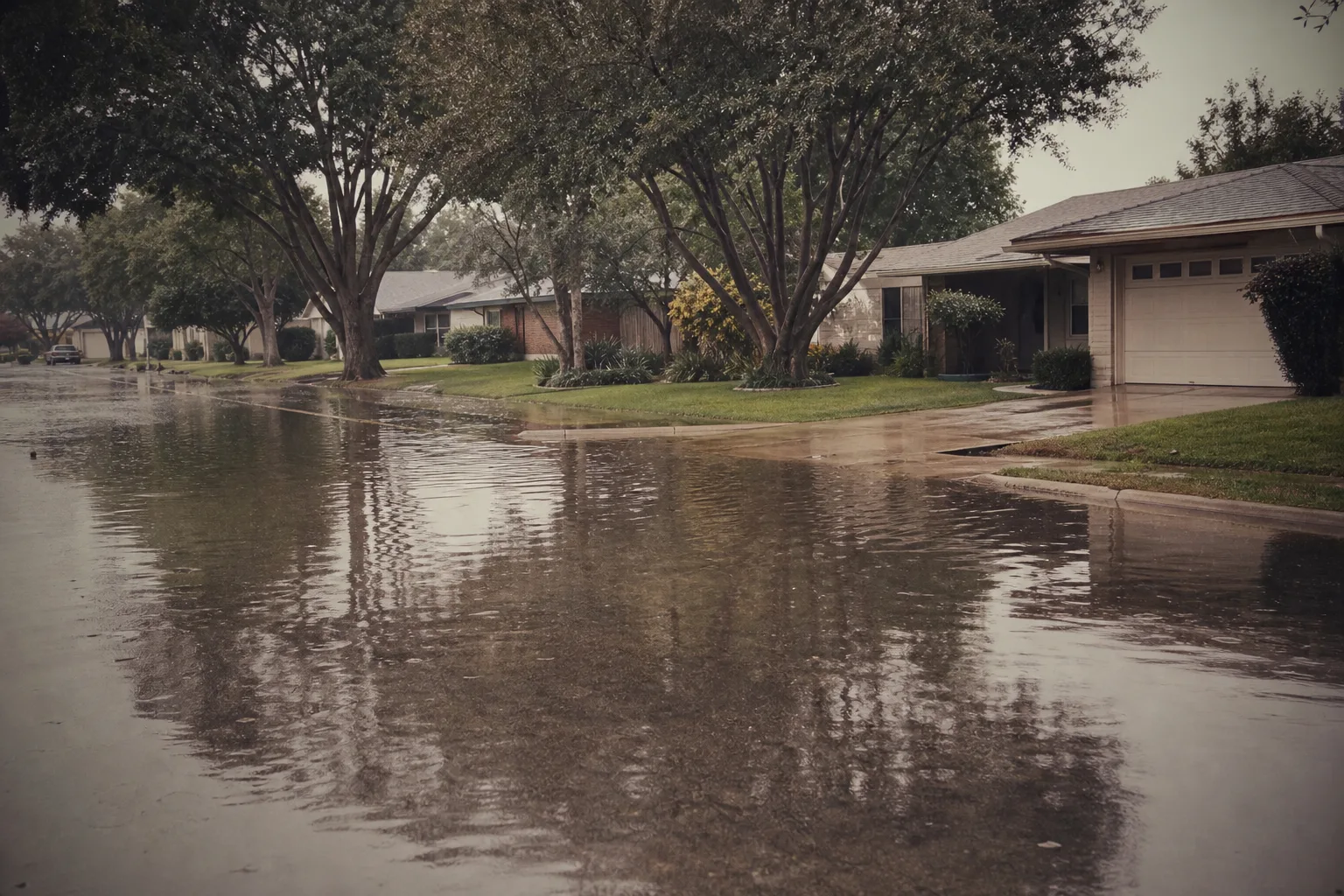
A homeowner reading their policy after a wet week often finds what looks like a contradiction: wind damage covered, a burst pipe covered, rain through a hole in the roof covered, and water that came in across the yard excluded outright. It reads as a technicality invented to avoid paying. It is nothing of the kind. The exclusion is the oldest structural fact in property insurance, and understanding why it is there explains almost everything about the separate system that grew up to fill the gap.
Why Private Insurers Stepped Away From It
Insurance works by pooling risks that are independent of one another, so that the unlucky few are paid by the fortunate many. Flood breaks that arithmetic completely, because when a river leaves its channel it does not damage one house in a thousand, it damages every house on the low side of a street at the same moment. A carrier holding concentrated exposure in a single valley faces a total loss across its entire local book on a single afternoon, which is the definition of an uninsurable risk in a private market.
The exclusion appeared in standard forms decades ago for exactly that reason, and it was less an abdication than an acknowledgment that this particular peril needed a different mechanism entirely. What replaced it was a federal program that spread the risk nationally, tied participation to community adoption of floodplain construction rules, and made coverage available in places no private carrier would have touched at any price. A private flood market has grown back alongside that program in a number of states, which is worth knowing when shopping, though the reason the exclusion exists has not changed.
What Legally Counts as Flood
The definition matters more than any other sentence in this area, and it is narrower than ordinary usage suggests. A flood is generally an overflow of inland or tidal water, or an unusual accumulation of surface water, affecting two or more acres or two or more properties. The two property requirement is the part that catches people, since water that damages only your house is by definition not a flood and belongs somewhere else entirely.
That distinction sorts the common cases cleanly once you see it. Rain driven through a roof opened by wind is wind damage on the homeowners policy. A sewer backup is neither flood nor a standard covered peril and requires its own endorsement, which is inexpensive and routinely declined by people who have never had one. Groundwater rising through a basement slab after a wet month is usually excluded by both policies, and that is the gap most likely to produce a genuinely unpleasant surprise.
Zones, and the Mistake Almost Everyone Makes With Them
Flood maps sort areas into zones, and a high risk designation carries a mandatory purchase requirement for anyone holding a federally backed mortgage. That requirement is what most households know about zones, and it produces the belief that a property outside the high risk area does not need the coverage. A very large share of claims come from moderate and low risk zones, which is the fact worth carrying away from any conversation about maps.
Maps are snapshots rather than statements about the future. They are redrawn as watersheds change, as development adds impervious surface upstream, and as studies are revised, and the Federal Emergency Management Agency is where the current map for a specific address can be looked up along with the history of what it used to say. A property that was low risk when it was bought may sit in a different category now, and the mortgage requirement is not what makes the water arrive.
The Waiting Period Nobody Plans Around
A new flood policy generally does not take effect for thirty days. That waiting period exists to stop people buying coverage as a storm approaches, which means it cannot be bought in response to a forecast, a wet spring, or news that the land upstream is being developed. Narrow exceptions exist, principally a policy bought in connection with a loan closing, and none of them helps somebody watching a weather report on a Thursday evening. The practical consequence is that flood coverage is a decision made in a quiet month, and the right time to think about it is a season when nothing is happening at all.
Working Out Whether the Coverage Belongs on Your House
Three questions get most households to an answer. What does the current map say about the address, which takes minutes to check and is worth checking rather than assuming. What has actually happened nearby, since neighbors, the county, and a long standing local agent collectively know more about which streets take water than any map does. And what would a foot of water in the lowest occupied level cost to put right.
The answer to the third question is usually a five figure number, which reframes the premium considerably. Coverage in a moderate risk zone is generally a modest annual cost, and it can be written for the structure alone, for contents alone, or for both. The line in the policy that looked like a technicality turns out to mark the boundary between two systems, and the gap between them is only a problem for the households that never noticed it was there.